
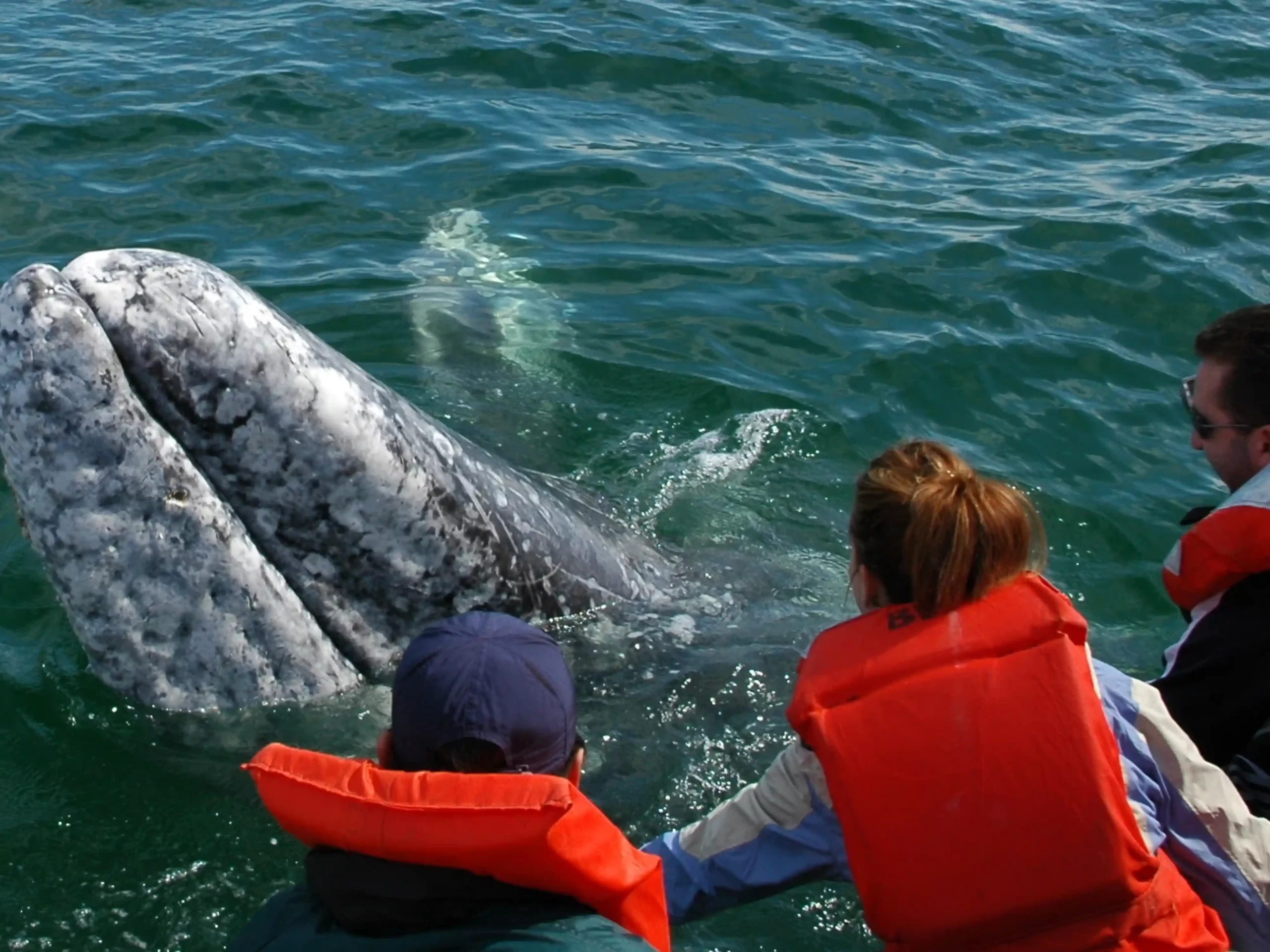
Quick answer: Whale watching in Baja is usually best from mid-January to mid-April, when gray whales gather in three major Pacific lagoons to give birth and nurse their calves. The three lagoons are Laguna Ojo de Liebre, Laguna San Ignacio and Magdalena Bay. Small boats called pangas take visitors out, and in these protected or regulated whale-watching areas, curious mothers and calves may approach boats on their own. Gray Whale Camp is based at Laguna Ojo de Liebre, where our schedule generally includes two boat trips of 2 to 3 hours per whale-watching day, weather permitting.
Key Takeaways
- Baja season:roughly mid-January to mid-April, with mother-and-calf activity often highest in late February and March
- Main species:Eastern North Pacific gray whale
- Where:three major gray whale lagoons on the Pacific side of Baja California Sur
- Gray Whale Camp:based at Laguna Ojo de Liebre; see our Schedule page for current trip dates
- Plan ahead:peak weeks are popular across the region
Why Baja Whale Watching Is Unlike Anywhere Else
Most whale watching happens in the open ocean, where visitors often watch spouts, backs and tails from a distance.
Baja Whale Watching can be different because gray whales migrate into shallow coastal lagoons where they breed, give birth and nurse their calves.
These lagoon environments can offer calmer conditions than the open ocean, while many whales remain in the same general area for an extended period during the season.
There is also a famous part of Baja whale-watching history.
In 1972, a gray whale in Laguna San Ignacio reportedly approached a local fisherman’s panga and allowed close contact. Since then, what has become known as “friendly whale” behavior has been reported in all three major gray whale lagoons.
However, these encounters are entirely voluntary.
Whales decide whether to approach a boat, and every experience depends on the animals’ behavior, weather, wind and conditions on the day.
The Three Baja Gray Whale Lagoons
This section provides general information about Baja’s three major gray whale lagoons.
Gray Whale Camp operates specifically at Laguna Ojo de Liebre.
Lagoon | Nearest town | Known for |
Laguna Ojo de Liebre | Guerrero Negro | Often large concentrations of gray whales; home of Gray Whale Camp |
Laguna San Ignacio | San Ignacio | Historic association with friendly whale encounters; remote setting |
Magdalena Bay | Puerto Adolfo López Mateos, Puerto San Carlos | Southernmost major lagoon system; accessible from areas farther south in Baja |
Each lagoon offers a different travel experience, setting and access route.
For more detail, read our guide to whale watching in Baja lagoons.
Laguna Ojo de Liebre
Laguna Ojo de Liebre, near Guerrero Negro, is one of Baja’s most important gray whale nursery and breeding areas.
It is also the location of Gray Whale Camp.
The lagoon is known for hosting significant numbers of gray whales during the winter season, including mothers with calves and adult whales.
Gray Whale Camp guests choose from our published trip dates at Laguna Ojo de Liebre rather than selecting between different lagoons.
For the actual dates we operate, always check our Schedule page.
Laguna San Ignacio
Laguna San Ignacio is another major gray whale lagoon and is well known for its remote setting.
It also has an important place in the history of Baja’s famous close whale encounters.
Travelers who visit this lagoon generally stay in or around San Ignacio or travel to dedicated camps and operators serving the lagoon.
This is regional information only. Gray Whale Camp does not operate at Laguna San Ignacio.
Magdalena Bay
Magdalena Bay is a large lagoon system farther south along Baja California Sur’s Pacific coast.
Whale-watching trips commonly depart from communities such as Puerto Adolfo López Mateos and Puerto San Carlos.
Because of its southern location, Magdalena Bay can have different seasonal timing and travel logistics compared with Ojo de Liebre and San Ignacio.
Again, Gray Whale Camp operates only at Laguna Ojo de Liebre.
When to Go Whale Watching in Baja
Gray whales generally begin arriving in Baja in late December, with numbers increasing through January.
The wider regional season typically continues through early or mid-April, although the exact timing varies from year to year.
Pregnant females are often among the earlier arrivals.
Mothers with calves frequently remain in the lagoons later in the season, giving calves time to build strength before beginning the long northbound migration.
For many travelers:
- Januarycan offer courtship activity and active adult whales
- Februaryoften brings strong whale numbers and increasing numbers of calves
- Marchis often popular for mother-and-calf encounters
- Early Aprilmay still have whales elsewhere in the region, although numbers generally decline
For a month-by-month overview of the wider season, read our Baja gray whale watching calendar.
For Gray Whale Camp’s actual operating dates, always refer to our Schedule page.
How a Boat Trip Works at Gray Whale Camp
A typical whale-watching outing at Gray Whale Camp follows a simple, wildlife-first process.
- You board a pangawith a licensed local captain.
- The boat enters the designated whale-watching area.
- Mexican whale-watching regulations govern how boats operate around the whales.
- The captain slows or stops the boat when whales are nearby.
- Curious whales may choose to approach.
- Each boat expedition generally lasts around 2 to 3 hours.
- Our schedule generally includes two boat trips per whale-watching day, weather permitting.
The most important thing to understand is that the boat does not chase whales for close contact.
Captains position the boat safely and allow the whales to decide whether they want to approach.
What Happens During a Close Encounter?
A close gray whale encounter can vary dramatically.
A whale may:
- Swim alongside the panga
- Surface near the boat
- Spy-hop nearby
- Circle the boat
- Bring a calf closer
- Approach briefly and then swim away
- Show no interest in the boat at all
Some gray whales are naturally curious, while others keep their distance.
There is no guaranteed formula for creating a close encounter.
Patience is part of the experience.
Why More Whale-Watching Days Can Help
Wind is one of the most common reasons lagoon boat trips are delayed, adjusted or rescheduled.
Even during peak season, conditions can change quickly.
For this reason, trips with more whale-watching days generally provide more opportunities to experience favorable weather and active whale behavior.
That does not guarantee a close encounter, but it reduces the pressure of relying on a single short outing.
What to Wear on a Lagoon Boat Trip
Even when Baja feels warm on land, mornings on the lagoon can feel surprisingly cold.
Wind and spray can make temperatures feel lower, especially during the first boat trip of the day.
Bring:
- A windproof jacket
- A water-resistant outer layer
- Warm fleece or insulated layer
- Beanie or warm hat
- Light gloves
- Polarized sunglasses
- Sun protection
- Shoes that can get wet
Layering is usually the most practical approach.
For a complete packing list, see our whale watching trip planning checklist.
Protecting the Whales
Responsible whale watching is essential to protecting Baja’s gray whale population and the habitats they depend on.
Laguna Ojo de Liebre and Laguna San Ignacio are within the El Vizcaíno Biosphere Reserve, and the Whale Sanctuary of El Vizcaíno was designated a UNESCO World Heritage Site in 1993.
These protections help safeguard key breeding and nursery habitat used by gray whales.
Other Baja whale-watching areas have their own regulatory and management frameworks, which is why it is more accurate to refer to the region as having three major gray whale lagoons, rather than implying that all three share exactly the same protection status.
Whale-watching operators should follow applicable Mexican regulations governing:
- Boat speeds
- Distance from whales
- Number of boats near animals
- Time spent around whales
- Designated whale-watching areas
Responsible operators never chase, crowd or intentionally harass whales.
Gray Whale Population Changes
The eastern North Pacific gray whale population has experienced significant changes in recent years.
NOAA Fisheries has reported a substantial population decline since 2016, along with periods of low calf production.
Gray whale numbers naturally fluctuate, and scientists continue monitoring abundance, calf production, mortality and environmental conditions.
For travelers, this means it is important to approach Whale Watching in Baja with realistic expectations.
No season, date or lagoon can guarantee a particular number of whales or a specific type of encounter.
How to Choose the Right Baja Whale-Watching Experience
If you are comparing trips around Baja, consider:
- Which lagoon the operator visits
- Number of whale-watching days
- Number and duration of boat outings
- Group size
- Accommodation style
- Transportation arrangements
- Captain and guide experience
- Wildlife-viewing practices
- What is included in the trip price
For a more detailed comparison checklist, read our guide on how to choose whale watching tours in Baja.
If you are interested specifically in Gray Whale Camp, our trips are based at Laguna Ojo de Liebre, so simply review the available options on our Schedule page.
Planning Your Trip
Once you decide when you would like to travel, the basic planning process is straightforward:
- Review the wider Baja gray whale season.
- Decide which destination or lagoon fits your overall trip.
- If traveling with Gray Whale Camp, choose from our published Laguna Ojo de Liebre
- Check transportation arrangements.
- Prepare your passport and travel documents.
- Pack warm layers for lagoon mornings.
- Leave some flexibility for weather.
Planning ahead is particularly useful during popular February and March travel periods.
Ready to Plan Your Trip?
If you want to experience gray whales at Laguna Ojo de Liebre, start with our Schedule page.
There you can see Gray Whale Camp’s current trip dates, trip lengths, inclusions and available transportation options.
Once you find a date that works for you, reserve your place or contact us with any questions before your trip.
Frequently Asked Questions
Whale-watching trips operate with licensed local captains and are subject to applicable boating and wildlife-viewing rules. Wear the provided life jacket and always follow your captain's instructions.
Sometimes a whale may voluntarily approach closely enough for contact.
However, you should never chase a whale or assume touching will be possible.
The whale decides whether to approach, and close contact is never guaranteed.
Always follow your captain's instructions.
The three major gray whale lagoons are:
- Laguna Ojo de Liebre
- Laguna San Ignacio
- Magdalena Bay
Gray Whale Camp operates only at Laguna Ojo de Liebre.
No. The lagoons do not all have exactly the same conservation designation or management structure.
For that reason, it is more accurate to call them the three major gray whale lagoons on the Pacific side of Baja California Sur.
Laguna Ojo de Liebre and Laguna San Ignacio are part of the El Vizcaíno Biosphere Reserve.
International travelers entering Mexico generally need valid travel documentation.
Requirements can change, so check current Mexican entry requirements before departure.
Gray Whale Camp is based at Laguna Ojo de Liebre near Guerrero Negro in Baja California Sur, Mexico
Each boat expedition generally lasts 2 to 3 hours. Our schedule generally includes two boat trips per whale-watching day, weather permitting.
Across the wider region, mid-February through March is often a strong period for whale numbers and mother-and-calf activity.
The best timing depends on what you want to see.
Check Gray Whale Camp's Schedule page for our actual trip dates.
No. Gray whales are wild animals.
Even during peak season, whether a whale approaches a boat depends entirely on the whale's behavior and the conditions that day.
No. Gray Whale Camp operates specifically at Laguna Ojo de Liebre.
The information about Laguna San Ignacio and Magdalena Bay in this guide is provided to help travelers understand the wider Baja whale-watching region.