
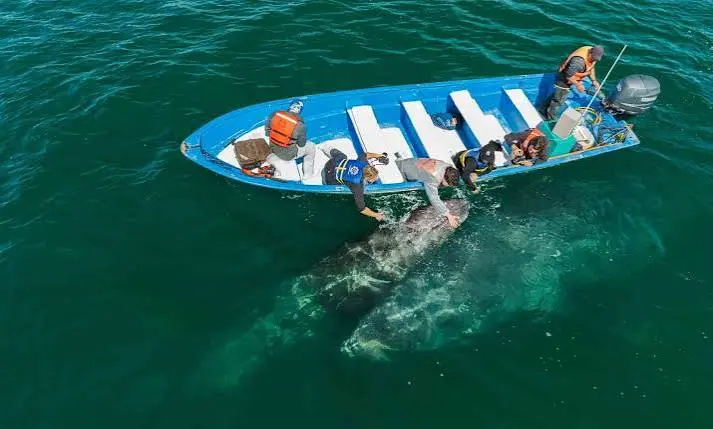
If you want to see gray whales in Baja, the short answer is this: head to one of the calving lagoons on the Pacific side of the peninsula, most famously Laguna Ojo de Liebre, between January and April, when mother whales bring their newborn calves into these sheltered waters and often approach small boats on their own. A single day tour from a resort town can show you whales at a distance, but a multi day, camp based whale watching trip on the lagoon itself is what gets you the close, boat side encounters Baja is actually known for. Here is what to know before you book.
Why Gray Whales in Baja Are Different From Whale Watching Anywhere Else
Gray whales migrate roughly 5,000 miles from feeding grounds in the Arctic to a handful of sheltered Baja California lagoons to give birth and raise their calves in calm, predator free water. What makes these particular lagoons unusual is that some mother whales, once their calves are strong enough, will approach boats voluntarily, sometimes close enough to touch, a behavior researchers still do not fully understand and one that essentially does not happen anywhere else gray whales are found. This is the reason a Baja gray whale watching trip is described so differently from whale watching elsewhere in the world.
When to Go: The Baja Gray Whale Season Month by Month
| Month | What to Expect |
| January | Early arrivals begin entering the lagoons; whale numbers are still building |
| February | Peak season; highest concentration of mothers and calves in the lagoons |
| March | Strong whale activity continues; calves are more active and curious |
| April | Later season; whales begin their northward migration back to Arctic waters |
Booking a trip in the middle of the season (roughly February through mid March) generally gives the best odds of close encounters, since that is when the highest number of mother and calf pairs are present in the lagoon at once.
Whale Watching Tour vs a Multi Day Whale Watching Trip
Not every whale watching tour in Baja is the same experience, and the difference matters more than most people expect before they book.
- A single day tour, often run from a nearby town or resort, typically includes one or two boat outings and a return to a hotel each night
- A multi day, lagoon side trip means staying in a camp directly on the water, with several boat outings across consecutive days rather than just one
- More boat outings generally means a higher chance of a close encounter, since whale behavior and lagoon conditions vary day to day
- Camp based trips also include naturalist guides who know the lagoon’s whale families and behavior patterns, not just a boat driver
Our Gray Whale Watching Baja Camp is built as the multi day version of this experience, with several boat outings over the course of the stay rather than a single trip.
Where It Happens: Life at the Lagoon
The camp sits directly on the shore of Laguna Ojo de Liebre inside the Vizcaíno Biosphere Reserve, one of the most protected and least developed stretches of the Baja California coastline. Guests stay in heated cabins rather than tents exposed to the elements, meals are provided at the camp itself, and each day typically includes a guided panga (small boat) outing onto the lagoon with an experienced local guide. Being based at the lagoon itself, rather than commuting in from a town each day, is a large part of why a camp based trip produces more consistent whale encounters than a single day tour.
Whale Watching Done Responsibly
Because gray whales approach boats voluntarily in these lagoons rather than being pursued, how a tour operator handles that interaction matters. Boat speed near whales, distance maintained until a whale approaches on its own terms, and group size in the water are all factors that affect both the whales and the quality of the experience. Our approach to responsible whale watching covers how these encounters are managed so the experience stays safe for the whales and genuine for guests, rather than staged or rushed.
Who You Are Actually Booking With
Baja Jones Adventures has run whale watching trips at this camp for more than 25 years, and that kind of continuity matters in a place where local knowledge of lagoon conditions, whale behavior, and seasonal timing is built up over years, not a single season. You can read more about the guide behind the camp on the About Keith Jones page, along with the experience that shapes how each trip is run.
Common Questions About Baja Gray Whale Watching
When is the best time to see gray whales in Baja?
February through mid March is generally the strongest window, when the highest number of mother and calf pairs are present in the lagoons, though the full season runs from January through April.
How close do gray whales actually get to the boats?
Some mother whales voluntarily approach small boats close enough for guests to touch them, though this is initiated by the whale, not the boat, and does not happen on every outing.
Is a multi day camp trip worth it compared to a single day tour?
If a close encounter is the goal, yes, since more boat outings across several days significantly improves the odds compared to a single outing on a single day tour.
What should I pack for a whale watching camp trip in Baja?
Warm layers for early mornings and evenings, sun protection for daytime boat outings, and comfortable clothing that can get wet, since lagoon conditions and spray are part of the experience.
Are gray whale watching trips safe for children and older travelers?
Most trips accommodate a range of ages, but boat conditions, camp accommodations, and daily activity levels vary by operator, so checking specifics before booking with a family or older travelers is worth doing.
How far in advance should I book a whale watching trip in Baja?
Since the season is short and lagoon access is limited by permit, booking as early as possible for the peak February to March window is strongly recommended, especially for group or family dates.
Ready to Book Your Trip
Gray whale season in Baja is short, and the best dates fill up well before the season starts, especially through the peak window in February and March. If you want to see this up close rather than from a distance, check the current season schedule and book your dates while the season you want is still open.