
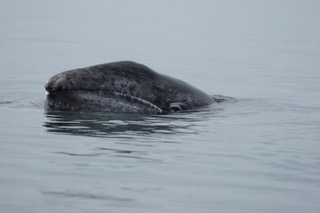
Short answer: Gray whales spend the winter in the Pacific side lagoons of Baja California Sur, principally Magdalena Bay, Laguna San Ignacio and Laguna Ojo de Liebre. Loreto sits on the opposite coast, on the Sea of Cortez, so while it is the most convenient airport and staging town for reaching Magdalena Bay, the gray whales are not in Loreto itself. Any gray whale trip based in Loreto involves crossing the peninsula, roughly a two hour drive, to reach the Pacific lagoons. The season runs from about mid January to early April, with February and March the strongest weeks. If your priority is close, unhurried encounters, a multi day camp on the lagoon delivers something a single day trip structurally cannot.
That geography point catches a lot of visitors out, and it is worth understanding before you book flights, because it determines your whole itinerary.
Where the gray whales actually are
Gray whales complete one of the longest migrations of any mammal, travelling roughly 10,000 to 12,000 miles round trip between Arctic feeding grounds and these shallow, warm, protected Baja lagoons, where they mate and give birth. The lagoons matter because the calm, salty, shallow water is ideal for newborn calves.
| Lagoon | Coast | Nearest useful airport | Character |
| Magdalena Bay, including Puerto López Mateos and Puerto San Carlos | Pacific | Loreto, about two hours by road | Large bay system behind barrier islands, mangroves and dunes, reachable from Loreto in a morning, options for both day trips and island camps |
| Laguna San Ignacio | Pacific | Loreto or Guerrero Negro, a long drive plus a dirt road | Remote, within the El Vizcaíno Biosphere Reserve, long standing reputation for curious whales approaching boats, camp based visits |
| Laguna Ojo de Liebre, also called Scammon’s Lagoon | Pacific | Guerrero Negro | Also inside the biosphere reserve, further north, typically visited on day trips from town |
Laguna San Ignacio and Laguna Ojo de Liebre sit inside the El Vizcaíno Biosphere Reserve, recognised by UNESCO as a World Heritage site for its whale sanctuary. Magdalena Bay lies further south and is a separate ecosystem, closer to Loreto and considerably easier to reach.
Loreto: what it is good for, and what it is not
Loreto is a genuinely lovely base, and it is the practical gateway for most travelers heading to Magdalena Bay. It just is not where the gray whales are.
| From Loreto | What you can expect |
| Boat trips within Loreto Bay National Marine Park, on the Sea of Cortez | Blue whales in season, fin whales, dolphins, sea lions at the islands, superb desert island scenery. A wonderful outing, and a completely different experience from the gray whale lagoons |
| Day trip across the peninsula to Puerto López Mateos, Magdalena Bay | Gray whales. Roughly two hours each way by road, leaving early, with a couple of hours on the water in the middle |
| Multi day camp on Magdalena Bay | Gray whales, with two or more outings a day and time on the water when conditions are best |
| Long overland trip to Laguna San Ignacio | Gray whales in the most remote of the lagoons, a serious drive, usually done as a multi day camp trip rather than a day trip |
If someone sells you gray whale watching in Loreto without mentioning the crossing, ask where the boat actually launches. The answer should be a Pacific side port. Blue whale trips from Loreto are excellent in their own right, and the two experiences are often combined into one holiday, but they are not interchangeable.
When to go, week by week
The season is defined by the whales’ migration, and the differences between early, middle and late season are real enough to influence when you book.
| Period | What is typically happening | Best for |
| Mid to late January | Whales arriving, numbers building, first calves being born | Fewer visitors, lower prices, slightly lower whale numbers |
| February | High numbers, many mothers with newborn calves, breeding activity | The most reliable combination of numbers and activity |
| March | High numbers, calves stronger and more mobile, often the most curious behaviour | Close encounters, calves actively investigating boats |
| Early April | Numbers declining as whales begin the northbound migration | Quiet lagoons, good value, more variable sightings |
If you can only choose one window, the second half of February through the third week of March is the sweet spot. Calves are a few weeks old by then, strong enough to be inquisitive, and mothers are often notably relaxed about letting them approach boats.
One practical note on weather. Mornings are usually calmer, with wind building through the afternoon in most of these lagoons. That is why camps run early outings, and it is one of the structural advantages of staying on the water rather than arriving mid morning from town.
Camp or day trip: an honest comparison
This is the decision that most affects what you actually experience, so it is worth setting out plainly rather than persuasively.
| Factor | Day trip from town | Multi day lagoon camp |
| Time on the water | Typically one outing, often two hours, arriving mid morning | Usually two outings a day across several days, including the calm early window |
| Weather flexibility | One shot. A windy morning is your whole trip | Several attempts. A poor session is followed by a better one |
| Travel each day | Two hours out, two hours back if based in Loreto | Travel once at the start and once at the end |
| Chance of a close, whale initiated encounter | Real but compressed into one window | Substantially better simply because you get many more hours on the water |
| Accommodation | Hotel comfort in town | Tented camp, simple rooms or cabins, shared bathrooms in many camps |
| Connectivity | Normal | Limited or no mobile signal, limited power. Most people come to consider this a feature |
| Cost | Lower per day | Higher per day, better value per hour with whales |
| Suits | Travelers with one free day, or those adding whales to a broader Baja trip | Anyone for whom the whales are the reason for the trip, photographers, families wanting unhurried time |
The core argument for a camp is not luxury. It is arithmetic. Whale encounters depend on conditions and on the whales’ mood, and neither is controllable. More attempts at better times of day produce better outcomes. Travelers who describe a life changing encounter are, overwhelmingly, the ones who were out on the water repeatedly rather than once. What that looks like day to day is set out under life at the camp.
What a day at a lagoon camp looks like
Rhythms differ between operators, but the shape is consistent.
Early start, usually with coffee before first light and breakfast either before or after the first outing, because the calm early hours are too valuable to spend at the table. Out in a panga, the small open skiff used throughout Baja, with a licensed local boat captain and a small group. Back mid morning for a proper breakfast or brunch. The middle of the day is for resting, walking the dunes or mangroves, birdwatching, reading, or a siesta. A second outing in the afternoon. Dinner together, usually excellent, usually local, and an early night because tomorrow starts early too.
The parts people remember afterwards are frequently not the whales. They are the silence, the absence of a phone signal, the stars, and the sound of a whale exhaling somewhere in the dark near the camp.
How to tell a good camp from a mediocre one
The keyword-friendly question is which camp is best. The useful question is what distinguishes a well run camp, because the answer lets you judge for yourself.
- Licensed operation and permits. Whale watching in these lagoons is regulated. Ask whether the operator holds the required permits and whether the boat captains are licensed. This is not a formality, it governs how many boats may be near a whale and how they behave.
- Boat captains from the local community. The families who have worked these lagoons for generations read the water and the whales better than anyone. It is also how tourism revenue reaches the people who live alongside the whales.
- Group size, on the boat and at camp. Six to eight guests per panga is common and workable. Ask the number rather than assuming.
- Number of outings included per day, and whether extra sessions are possible when conditions are good.
- Guide knowledge. Someone who can explain behaviour, identify other wildlife and read conditions transforms the experience.
- Honesty about the accommodation. A good operator tells you plainly about shared bathrooms, cold nights, limited power and no signal. Vague descriptions usually mean the reality would disappoint.
- What is included. Meals, transfers from Loreto or elsewhere, park and permit fees, equipment. Compare complete packages, not headline prices.
- A stated policy on whale approach etiquette, which tells you how they think about the animals.
- Bad weather policy. What happens if wind cancels a session, and what happens if it cancels several.
Comparing what is included across the available trip options is generally more revealing than comparing nightly rates, because inclusions vary widely between operators.
The friendly whales, and how to behave around them
These lagoons are famous for something unusual. Gray whales, and particularly mothers with calves, sometimes approach boats deliberately, hold alongside, and allow themselves to be looked at closely. Calves are often the instigators, and mothers frequently seem to permit or even encourage it.
Two things are worth understanding about this.
It is initiated by the whale, not the boat. Regulations require boats to maintain distance and to avoid pursuing, cutting across or crowding whales, with limits on how many boats may be near an animal and for how long. When a whale chooses to come to the boat, that is the whale’s decision. Any operator who describes chasing whales for a closer look is describing something both unethical and against the rules.
Encounters cannot be promised. Some days a lagoon is full of curious whales. Some days you watch spouts at a respectful distance and go home moved anyway. Any operator guaranteeing a friendly encounter is selling something they do not control. The honest version is that repeated outings over several days make a close encounter likely, not certain.
On etiquette in the boat: keep movements calm, keep voices low, do not lean or reach out to touch an animal, do not use flash, follow the captain without debate, and stay seated when asked. Sunscreen and insect repellent on hands are worth avoiding before an outing, for obvious reasons.
What to bring
- Layers, and more than you expect. Mornings on the water are cold even when the days are warm. A windproof and waterproof outer layer matters more than a heavy one
- Sun protection. Wide brimmed hat with a chin cord, since it will blow off otherwise, plus sunglasses with a strap and high factor sunscreen. Reflected glare off the water is intense
- Dry bag for the camera and phone. Spray is guaranteed
- Binoculars, useful for both whales and birds
- Motion sickness remedy taken before boarding rather than after
- Cash in pesos, since card facilities and ATMs are limited or absent near the lagoons
- Headlamp or torch, for camps with limited power
- Refillable water bottle
- Camera thoughts. A mid range zoom is more useful than a long lens when whales come close. A polarising filter helps. Bring more battery than you think, since charging may be restricted
- Any prescription medication, in sufficient quantity, since pharmacies are far away
Leave behind expectations of connectivity. Tell people at home you will be out of contact for the duration.
The other wildlife, which nobody warns you about
Visitors arrive for gray whales and frequently leave talking about everything else. Depending on the lagoon and the season, that can include bottlenose dolphins, sea lions, coyotes patrolling the beaches at dawn, ospreys, magnificent frigatebirds, herons, pelicans, and large numbers of migratory shorebirds and waterfowl in the mangroves and shallows. The desert and dune landscape behind the beach is worth walking with the same attention you give the water.
If your itinerary also includes Loreto and the Sea of Cortez, that is a genuinely different set of species again, with blue whales in season being the headline.
A note on conservation
The eastern North Pacific gray whale is one of the more encouraging conservation stories, having recovered sufficiently from commercial whaling to be removed from the US endangered species list in the 1990s. The population has, however, been through a difficult recent period, with elevated mortality and reduced numbers documented over several years, thought to be linked to changing conditions in the Arctic feeding grounds. Estimates are revised annually, so current figures are best taken from the relevant fisheries science agency rather than from a tour operator’s website.
What this means for visitors is straightforward. Regulated, permit based, community operated whale watching is part of why these lagoons are protected at all, since it gives the whales measurable economic value to the people living beside them. Choosing a licensed operator that employs local captains is the single most useful thing a visitor does.
Frequently asked questions
Can you see gray whales in Loreto?
Not in Loreto itself. Loreto is on the Sea of Cortez, and gray whales winter in the Pacific side lagoons. Loreto is the most convenient airport and staging town for reaching Magdalena Bay, which is roughly two hours away by road across the peninsula. From Loreto’s own waters you can see blue whales, fin whales, dolphins and sea lions in season, which is a superb but different experience.
When is the best time for gray whale watching in Baja?
Mid January to early April, with the strongest weeks generally from late February through the third week of March. By then calves are a few weeks old, active and often curious, and whale numbers in the lagoons are still high.
Which lagoon is best for gray whales?
Magdalena Bay is the most accessible, especially from Loreto, and offers both day trips and camps. Laguna San Ignacio is more remote and has a long reputation for curious whales approaching boats. Laguna Ojo de Liebre is further north and usually visited from Guerrero Negro. All three are genuine gray whale nurseries, so accessibility and the kind of trip you want usually matter more than the lagoon itself.
Is a whale camp better than a day trip?
For most people whose main reason for travelling is the whales, yes. A camp provides several outings across several days, including the calm early morning window, which substantially improves your chances of a close, whale initiated encounter. A day trip is a good choice if you have limited time or are adding whales to a wider Baja itinerary.
Will the whales come right up to the boat?
Often, but it cannot be promised. In these lagoons gray whales, particularly calves, sometimes approach boats of their own accord and stay alongside. Boats are required to keep their distance and never to pursue whales, so the encounter is always the whale’s choice. More time on the water across more days makes it considerably more likely.
Is gray whale watching safe for children?
Generally yes, and children often love it, though small children should be comfortable in a small open boat wearing a life jacket for a couple of hours. Check the operator’s minimum age, ask about the boat and camp setup, and be realistic about cold mornings and limited facilities.
How do I get to the Baja whale lagoons?
Most visitors fly into Loreto, which has seasonal direct services from several North American cities, then travel overland to Magdalena Bay. Los Cabos and La Paz are alternative arrival points with longer drives. For Laguna Ojo de Liebre, Guerrero Negro is the base. Confirm with your operator whether transfers are included, since this affects both cost and logistics.
Do I need a wetsuit or any special equipment?
No. Whale watching here is done from small open boats, not in the water, and swimming with the whales is not permitted. Warm layers, a windproof outer shell, sun protection and a dry bag are what you actually need.
What if the weather cancels our outing?
Wind is the usual constraint, and it typically builds through the afternoon. Camps handle this better than day trips because a missed session can be replaced the next morning. Ask any operator directly what their policy is when conditions prevent an outing.
Next step
The two decisions that shape everything else are which weeks you can travel and whether you want a camp or a day trip. Once those are settled, the itinerary largely arranges itself. If you are weighing dates, group size or how the camp connects with time in Loreto, the common questions page covers most of it, and you can ask about specific dates and availability directly. Booking well ahead is advisable for the late February to mid March window, which fills first every season.
Written from seasons spent on the gray whale lagoons of Baja California Sur. Whale behaviour and sightings vary naturally and cannot be guaranteed. Access, permits, travel times and population figures change, so confirm current details when planning.