
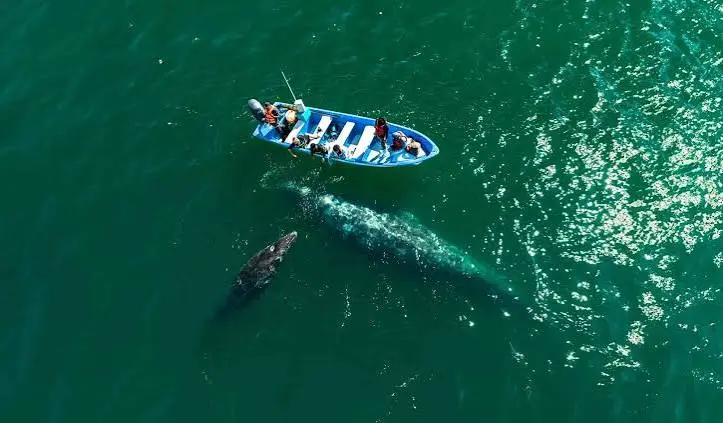
The best gray whale camp in Baja comes down to three measurable things: which lagoon it’s on, how many boats are allowed to share the water with you, and whether you’re paying for scenery or for whale density backed by actual census numbers. Most guides to gray whale watching in Baja lean on descriptions of “gentle giants” and “unforgettable encounters.” Those things are true, but they don’t tell you why one camp location produces more close encounters than another.
This is a comparison built on the numbers behind that choice, government census data, boat-zone limits, and real 2027 pricing, rather than another general overview of why Baja is beautiful.
Why Lagoon Choice Decides Everything
Not all Baja whale watching happens in the same place. Two lagoons account for most of the gray whale nursery activity: Laguna Ojo de Liebre (also called Scammon’s Lagoon) and San Ignacio Lagoon, roughly 150 miles further south.
The distance matters biologically. A pregnant gray whale swims roughly 5,000 miles from Arctic waters to reach Baja. Laguna Ojo de Liebre is the first major sheltered bay she reaches, which is a meaningful part of why whale density there tends to run higher than lagoons further along the coast.
There’s also a structural difference in how each lagoon manages boat traffic. San Ignacio operates one whale watching zone that permits 16 boats at a time. Laguna Ojo de Liebre is divided into three separate zones, with the zone directly off Gray Whale Camp limited to just 6 boats. Fewer boats sharing the same water generally means less disturbance and more consistent close encounters.
Whale Census Numbers: Laguna Ojo de Liebre vs San Ignacio
Rather than relying on general claims about whale density, here’s Mexican government census data comparing both lagoons across the 2024 and partial 2025 seasons:
| Date | San Ignacio Lagoon (total whales) | Laguna Ojo de Liebre (total whales) |
| Jan 29, 2024 | 20 | 370 |
| Feb 12, 2024 | 46 | 594 |
| Feb 19, 2024 | 116 | 758 |
| Feb 26, 2024 | 210 | 629 |
| Feb 4, 2025 | 17 | 235 |
| Feb 19, 2025 | 73 | 568 |
| March 13, 2025 | 40 | 414 |
Across nearly every recorded date, Laguna Ojo de Liebre shows five to ten times the whale count of San Ignacio Lagoon. The gap is consistent enough across two full seasons that it’s a reasonable basis for choosing a lagoon, not just a one-time anomaly.
What a Camp Stay Actually Looks Like
Beyond the water, the practical side of “at the lagoon” versus “a day trip that includes the lagoon” makes a real difference:
- Boarding method. At San Ignacio, guests typically wade out to the boats, wet feet, wet pants, and a real risk of dropping gear in the shallows. Camps with dock access, like Gray Whale Camp, let guests step directly into the boats.
- Accommodations. Safari-style tents and cabins with real beds, warm blankets, gas-heated showers with 24-hour hot water, and flush toilets, positioned close enough to hear whales surfacing at night.
- Meals. Three meals a day, with dinner typically a multi-course meal built around regional Baja ingredients and traditional preparation methods, not a basic camp-food setup.
- Excursions. Most itineraries include two boat trips per whale watching day, weather permitting, rather than a single outing.
- No single supplement. Solo travelers are a meaningful share of whale watching guests, and camps that charge extra for solo accommodation add real cost to a trip that’s already a significant travel investment.
Baja Whale Watching Pricing: What 2027 Trips Actually Cost
Pricing for a Baja gray whale camp trip generally scales with trip length, with early bookings priced lower before rising as dates fill:
| Trip Length | Typical 2027 Price Range | Notes |
| 4 days / 3 nights | $2,995 to $4,095 | Two travel days, two whale watching days |
| 5 days / 4 nights | $3,895 to $4,295 | Two travel days, three whale watching days |
| 6 days / 5 nights | $3,795 to $4,595 | Two travel days, four whale watching days |
| 8 to 10 day gray & blue whale combo | $4,795 to $5,195 | Adults-only combo itinerary, both species |
Prices at Gray Whale Camp rise as each trip date fills, with no last-minute discounting offered on dates that haven’t sold out, and a limited number of en-suite upgrade cabins that tend to sell out earliest. See the full 2027 schedule and pricing for exact trip dates.
Getting to a Baja Whale Watching Camp
Access is worth planning around, since it affects both cost and trip reliability:
- Flight via Ensenada. Ground transport from San Diego to Ensenada, then a roughly 2.5-hour flight to the airfield near camp. Fastest option, but flights are delayed or canceled on an estimated 10 to 20 percent of departures.
- Ground transport from San Diego. A single roughly 10-hour drive door to door. Slower, but has never been canceled or rescheduled across more than 30 years of operation.
- Ground transport from Yuma. A shorter, less-trafficked route than the San Diego drive, using a newer highway with fewer towns along the way.
- Fly into Loreto, then drive. Useful if flight availability to Loreto works better for your starting point. Involves an overnight stay in Loreto before a roughly 6-hour drive to camp the next morning.
Flights operate Monday, Wednesday, and Friday only. Ground transport can run any day.
Choosing the Best Gray Whale Camp: A Practical Checklist
- Which lagoon is the camp actually on? Ask directly, “near Baja” and “on Laguna Ojo de Liebre” are not the same claim.
- How many boats share the whale watching zone? Fewer boats generally means more consistent, closer encounters.
- Dock or wading access? Matters for comfort and gear safety, not just convenience.
- Is there a single supplement fee for solo travelers?
- How long has the operator run trips in this specific location? Track record matters more than a polished website. Baja Jones Adventure Travel has operated this camp for over 25 years.
- Is the camp inside a protected reserve? Gray Whale Camp sits inside the Vizcaíno Biosphere Reserve with gated access, which affects both conservation practices and the quality of the surrounding wilderness.
Frequently Asked Questions
Is Laguna Ojo de Liebre better than San Ignacio Lagoon for whale watching?
Based on 2024 and 2025 government census data, Laguna Ojo de Liebre consistently recorded five to ten times more whales than San Ignacio Lagoon. It’s also the first major sheltered lagoon gray whales reach after their migration, and it’s divided into three boat-traffic zones rather than San Ignacio’s single 16-boat zone.
How many boats are allowed in each whale watching zone in Baja?
This varies by lagoon and zone. San Ignacio Lagoon permits up to 16 boats in its single zone. Laguna Ojo de Liebre is divided into three zones, with the zone directly off Gray Whale Camp limited to 6 boats.
Do solo travelers pay more for a Baja whale watching trip?
Not at every camp, policies vary by operator. Gray Whale Camp does not charge a single supplement or require solo travelers to share accommodations.
What’s included in the price of a Baja gray whale camp trip?
Typically all meals while at camp, accommodations, towels and bedding, and the scheduled boat excursions. Meals during travel to and from camp are usually not included. Confirm specifics directly with the operator before booking.
How do I get from San Diego to a Baja whale watching camp?
The main options are a flight via Ensenada (roughly 2.5 hours, with some cancellation risk), a direct ground transport route (about 10 hours, historically never cancelled), or a route via Yuma using a less-trafficked highway.
Book Your Trip
If the numbers above are enough to help you choose, view the full 2027 schedule and current pricing, explore what a stay at Gray Whale Camp actually includes, or get in touch with specific questions about dates, travel options, or availability.