
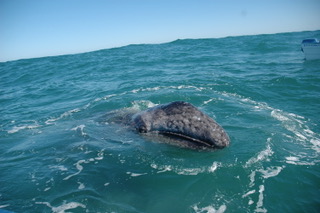
Quick answer: The gray whale season in Baja’s lagoons runs from late December through late March. Whale numbers in Laguna Ojo de Liebre build sharply through January, peak in mid to late February, and taper through March. If you want the highest whale counts, book mid February. If you want the closest, friendliest encounters, late March has a long track record of exceptional interaction with fewer whales present. If you want the lowest price, book the opening trips in late January. All three are good trips. They are just different trips, and this guide explains how to pick the one that matches what you actually want.
There is one more thing worth knowing before you read further: prices rise as each date fills, and the most popular dates sell out months before the migration begins. Timing your decision matters almost as much as timing your trip.
The gray whale season, explained
Every winter, gray whales complete one of the longest migrations of any mammal on earth. They leave their summer feeding grounds in the Arctic waters of the Bering and Chukchi Seas and swim roughly 5,000 to 6,000 miles south along the Pacific coast of North America to a handful of shallow, sheltered lagoons on the Pacific side of Baja California.
They come for one reason: these lagoons are the safest nursery available. The water is warm, shallow, protected from open ocean swell, and salty enough to give newborn calves extra buoyancy while they learn to swim and build a blubber layer.
The rough timeline:
| Period | What is happening |
| Late December | First arrivals reach the lagoons. In the 2026 migration, gray whales began arriving on 22 December |
| January | Numbers build rapidly. Pregnant females arrive first and begin giving birth |
| Early to mid February | Peak population. Mothers with newborn calves fill the lagoon |
| Late February | Peak calf numbers. Calves are strong enough to be curious |
| March | Adults begin the northbound journey. Mothers and calves stay longest |
| Late March | Fewest whales, but often the most interactive. Calves are large, confident and playful |
Two things follow from this. First, there is no single “best” week, because whale numbers and whale behaviour peak at different times. Second, anyone who tells you a specific week is guaranteed is overselling. These are wild animals in a large lagoon, and conditions vary year to year.
What the census data actually shows, week by week
The Mexican government conducts a periodic census of gray whales in the lagoons. Below are the figures for Laguna Ojo de Liebre, the lagoon our camp sits on, across two recent seasons. This is the most useful planning data available, and almost nobody publishes it.
Laguna Ojo de Liebre, total whales counted
| Date | 2024 season | 2025 season |
| 15 January | 42 | |
| 24 January | 194 | |
| 29 January | 370 | |
| 4 February | 235 | |
| 12 February | 594 | |
| 19 February | 758 | 568 |
| 26 February | 629 | |
| 13 March | 414 | |
| 14 March | 125 | |
| 20 March | 99 | |
| 21 March | 237 | |
| 28 March | 39 |
Calves counted in Laguna Ojo de Liebre
| Date | 2024 season | 2025 season |
| 15 January | 14 | |
| 24 January | 55 | |
| 29 January | 117 | |
| 4 February | 30 | |
| 12 February | 179 | |
| 19 February | 177 | 66 |
| 26 February | 180 | |
| 13 March | 91 | |
| 14 March | 27 | |
| 21 March | 48 |
What this tells you
The build is steep. Between mid January and late January 2024, the count went from 42 whales to 370. If you book the very first days of the season you are trading whale numbers for the lowest price of the year, and that is a legitimate trade if budget is your priority.
Peak is mid to late February. Both seasons show the highest counts between roughly 12 and 26 February. Calf numbers peak in the same window. If your goal is simply to see as many whales as possible, this is your window.
March varies a great deal between years. Look closely at the two columns. In 2024, numbers had collapsed to 125 by 14 March. In 2025, there were still 414 whales on 13 March and 237 on 21 March. Same lagoon, same calendar week, very different years. Anyone who promises you a specific March outcome is guessing.
Fewer whales does not mean a worse trip. Our late March trips have consistently produced outstanding close encounters. With fewer whales in the lagoon, the ones that remain are mostly mothers with well grown, confident calves, and those calves are the ones that come to the boats. Many of our repeat guests deliberately book late March for exactly this reason.
A note on the recent population decline
Gray whales went through what NOAA classified as an Unusual Mortality Event beginning around 2019 to 2020, which scientists declared concluded in 2024. Population recovery from previous events of this kind has historically taken five to ten years, so counts in the near term may remain below the highs seen in earlier decades. We publish the census figures openly rather than quoting a best ever year, because you deserve a realistic expectation before you spend money on a trip.
Which week should you book?
Match the column that describes you.
| If your priority is | Book | Why |
| Lowest price | Late January opening trips | Our opening dates are always the lowest price of the season |
| Maximum whale numbers | 12 to 26 February | Census consistently peaks in this window |
| Maximum calves | Mid to late February | Calf counts peak alongside total counts |
| Closest, friendliest encounters | Mid to late March | Fewer whales, but grown calves that actively approach boats |
| Best value in the late season | Mid to late March | Prices come back down after the February peak |
| A long weekend | Presidents’ Day dates in February | Four and five day options built around the Monday holiday |
| Gray whales plus blue whales | Early February or early March combo trips | The only dates that include both species |
Our honest recommendation for a first trip: if you can travel in February, do. You get the highest probability of large numbers and abundant calves. If February does not work, take late March over late January. The whale count is similar but the interaction quality is usually better.
Why the lagoon you choose matters more than the week
Three Baja lagoons host gray whales: Laguna Ojo de Liebre, San Ignacio Lagoon, and Magdalena Bay. Most visitors research weeks carefully and then pick a lagoon almost by accident. That is backwards.
The census comparison
Here is the same government census data, comparing Laguna Ojo de Liebre with San Ignacio Lagoon.
| Date | San Ignacio total | Ojo de Liebre total | Ratio |
| 29 January 2024 | 20 | 370 | 18x |
| 12 February 2024 | 46 | 594 | 13x |
| 19 February 2024 | 116 | 758 | 6.5x |
| 26 February 2024 | 210 | 629 | 3x |
| 4 February 2025 | 17 | 235 | 14x |
| 19 February 2025 | 73 | 568 | 8x |
| 13 March 2025 | 40 | 414 | 10x |
Across these counts, Laguna Ojo de Liebre held roughly five to ten times as many whales as San Ignacio. Magdalena Bay counts are consistently lower than San Ignacio, which is why they are not shown.
Why the whales choose this lagoon
Think about it from a pregnant whale’s perspective. She has swum 5,000 miles or more and is close to giving birth. Laguna Ojo de Liebre is the first large, sheltered lagoon she reaches. San Ignacio is roughly another 150 miles further south, which is one to three additional days of swimming. Most mothers stop at the first safe option.
Three practical differences
Boat density. San Ignacio has one whale watching zone permitting sixteen boats at a time. Laguna Ojo de Liebre has three large zones. Our camp sits on the shore of Zone 2, where only six boats are permitted. Fewer boats around a whale means better encounters and less competition for position.
Getting into the boat. At San Ignacio, everyone wades out to the boats and climbs over the side of a panga, carrying cameras and shoes. Morning temperatures are typically in the mid 50s Fahrenheit with wind. Wet feet and wet trouser legs are normal, and a slip on the muddy bottom has ended more than a few cameras and phones. We have a dock. You step down into the boat dry.
Time on the water. Because the camp sits on the lagoon shore, you are minutes from the whales rather than driving to them. That is what makes two boat trips a day possible.
You can read more on our approach in responsible whale watching and see the setting in the gallery.
How to choose your trip length
This is the decision most people get wrong, and it is easy to fix once you understand how the days are counted.
Every trip includes two travel days. Those days are long and interesting, but they are not whale days. So the useful question is not how many days the trip is, it is how many whale watching days you get.
| Trip length | Nights | Actual whale watching days | Approx. boat trips |
| 4 day | 3 nights | 2 days | 4 |
| 5 day | 4 nights | 3 days | 6 |
| 6 day | 5 nights | 4 days | 8 |
| 8 day | 7 nights | 6 days | 12 |
| 10 day combo | 9 nights | Gray and blue whale days | Varies |
Two boat trips are scheduled each whale watching day, weather permitting.
Why weather makes trip length a real decision
Boat trips can be delayed or cancelled by wind. On a four day trip you have two whale days, so one windy day removes half your water time. On a six day trip you have four whale days, and a single bad day is a much smaller loss.
The practical guidance: if you are traveling a long way to get here, or this is a once in a lifetime trip, book at least the five or six day option. The marginal cost per extra whale day is small compared to the cost of getting to Baja in the first place, and the insurance against weather is real.
Four day trips work well for guests within easy reach of San Diego, repeat visitors who already have their photographs, and anyone fitting the trip around a holiday weekend.
Getting there: four routes and their real trade offs
We offer several travel options because travelers are not all the same. Ground transport between San Diego or Yuma and camp can run any day. Flights operate only Monday, Wednesday and Friday in either direction. Flight and ground transport are priced the same.
| Route | Travel window | The upside | The honest downside |
| Standard: San Diego, ground to Ensenada, flight, van to camp | Approx. 7:00 am to 3:30 pm | A pleasant 2.5 hour flight instead of a long drive | The flight is delayed or cancelled on roughly 10 to 20 percent of departures |
| Ground transport, San Diego to camp | Approx. 5:30 am to 5:30 pm | In over 30 years we have never cancelled or moved a ground route trip | Roughly 10 hours of driving |
| Ground transport, Yuma to camp | Approx. 5:30 am to 4:00 pm | Highway 5 is quieter, less populated and nearly 100 miles shorter; never cancelled | Still a long drive rather than a flight |
| Fly into Loreto, then ground to camp | Overnight in Loreto, then approx. 8:00 am to 3:00 pm | Almost never disrupted by flight timing; you can fly from anywhere | Requires an extra night in Loreto, which some guests enjoy and others do not |
| Fly Hermosillo to Guerrero Negro | We meet your flight | Seldom cancelled, and we deduct $500 per person from the standard price | You arrange and manage the flight yourself |
Our standard meeting point is the DoubleTree Hilton Bayside on Harbor Drive in San Diego, departing at 7:00 am, returning around 4:00 pm.
Which would we suggest? If flight reliability matters more to you than a long day in a van, take one of the ground routes. Guests who have taken the Yuma route often prefer it. If you would rather trade a small risk of disruption for a much shorter travel day, take the standard flight option. There is no wrong answer, and we are happy to talk it through.
What a day at camp actually looks like
You are not staying in a town and driving to the water. You live on the shore of Laguna Ojo de Liebre, inside the Vizcaíno Biosphere Reserve, for the whole trip. On quiet nights you can hear whales surfacing and blowing from your tent.
A typical whale watching day:
- Early breakfast in the dining tent
- First boat trip of the morning, stepping down onto the boat from the dock
- Time on the water among mothers and calves
- Return to camp, lunch, rest, warm up
- Second boat trip in the afternoon
- Dinner, and usually a long conversation about what everyone saw
- Whale sounds through the night
The accommodation is upscale safari tents and cabins, including heated cabins and en suite shower cabin upgrades. The upgrade cabins are limited and frequently sell out early.
For a fuller picture, see a real day at a Baja whale watching camp, hour by hour and the Gray Whale Watching Baja Camp page.
Adding blue whales to your trip
Blue whales are the largest animals that have ever lived, and they winter in the Sea of Cortez on the opposite side of the peninsula. A few of our dates combine both species.
- Blue whales began arriving around 1 January in the most recent season, slightly after the first gray whales
- Combo trips run 8 and 10 days and cover both the Pacific lagoon and the Sea of Cortez
- Some combo trips start from Loreto rather than San Diego
- Certain combo dates are adults only, so check the specific date
If seeing both a gray whale calf beside your boat and a blue whale in open water in one trip appeals to you, these are the only dates that do it. See blue whale expeditions and whale watching Loreto.
What is included, and what to bring
Included
- All accommodation in safari tents or cabins
- All meals while in camp
- All scheduled boat trips
- Guiding throughout
- Towels, robes, slippers, shampoo, conditioner, body soap and all bedding
- Transport on your chosen route
Note: meals are not included during travel north or south, so plan for those.
What to bring
Clothing. Layers are the whole strategy. Mornings on the water are typically in the mid 50s Fahrenheit with wind, and afternoons can be pleasant and sunny. Bring a windproof outer layer, a warm mid layer, a hat that will not blow off, and gloves. Many guests underestimate how cold a moving boat feels at dawn.
Sun protection. High UV, reflective water, and you will be outdoors most of the day. Sunscreen, lip balm with SPF, and polarised sunglasses.
Cameras. Bring more storage and more battery than you think you need, because cold drains batteries faster. A dry bag or waterproof case is sensible even though our dock keeps you dry boarding. A mid range zoom is usually more useful than a very long lens, because the whales come close.
Documents. A valid passport for crossing into Mexico. Check current entry requirements before you travel.
Medication. Bring anything you take regularly, plus motion sickness remedies if you are prone to it. The lagoon is sheltered and generally calm, but bring it anyway.
Solo travelers, families and photographers
Solo travelers. We charge no single supplement, ever, and we do not force anyone to share accommodation. This is unusual in small group travel and it is deliberate. Solo guests are a large and welcome part of most trips, and the dining tent tends to make introductions for you.
Families. Family safari tents are available. Gray whale calves are, genuinely, the best possible wildlife introduction for a child, because they come to you. Do check individual dates, since some are marked adults only.
Photographers. Book the longer trips. More whale days means more chances at the light and behaviour you want, and the second boat trip of the day often has better light than the first. The en suite upgrade cabins are worth it if you want somewhere warm and private to manage gear at the end of the day.
How pricing works and when to book
Our pricing works differently from most tour operators, and understanding it saves you money.
Prices start low and rise as dates fill. Each date opens at its lowest price. As sign ups accumulate, the price increases. This rewards early bookers rather than bargain hunters.
We do not discount at the last minute. If a date has not sold out, the price still does not drop. Late discounting is unfair to the guests who committed early, so we do not do it.
The consequence is straightforward: the best price on any date is available today, and it will not be better later.
Two further points on timing. The en suite shower cabin upgrades are limited and sell out early. And the most popular dates are typically full long before the migration even begins.
2027 season prices range from $2,995 for a four day opening trip to $5,195 for a ten day gray and blue whale combination. Full dates and prices are on the 2027 schedule.
FAQs
When is the best time to see gray whales in Baja?
The season runs from late December to late March. Whale numbers in Laguna Ojo de Liebre peak between roughly 12 and 26 February, based on government census counts across recent seasons. Late March typically has fewer whales but a strong track record of very close, interactive encounters with well grown calves.
How many gray whales are in the lagoon during peak season?
Census counts for Laguna Ojo de Liebre reached 758 whales on 19 February 2024 and 568 on 19 February 2025. Early season counts in mid January are far lower, around 42 in 2024, and numbers taper through March at rates that vary considerably year to year.
Which Baja lagoon has the most gray whales?
Laguna Ojo de Liebre. Across recent government census counts it has held roughly five to ten times as many gray whales as San Ignacio Lagoon. Magdalena Bay counts are consistently lower than San Ignacio.
Why do gray whales prefer Laguna Ojo de Liebre?
It is the first large, sheltered, shallow lagoon that northbound pregnant females reach on the Pacific coast of Baja. San Ignacio is roughly 150 miles further south, an extra one to three days of swimming for a whale close to giving birth.
Do gray whales really come up to the boats?
Yes, and it is the whales that initiate it. Calves in particular are curious and will approach boats on their own. This behaviour is well documented in the Baja lagoons and is the reason people travel here rather than to other whale watching destinations.
How many days should I book?
Every trip includes two travel days, so a four day trip gives two whale watching days, a five day gives three and a six day gives four. Because wind can delay or cancel a boat trip, longer trips give meaningful protection against losing water time. For a first or long distance trip, five or six days is the better choice.
How do I get to the camp?
Options include ground transport from San Diego to camp, ground transport from Yuma via Highway 5, our standard route combining ground transport to Ensenada with a flight, flying into Loreto with an overnight and a drive, or flying Hermosillo to Guerrero Negro. Flights operate Monday, Wednesday and Friday; ground transport runs any day. Flight and ground options cost the same.
Is there a single supplement for solo travelers?
No. We never charge a single supplement and we never require solo guests to share accommodation.
What is included in the price?
Accommodation, all meals while in camp, all scheduled boat trips, guiding, transport on your chosen route, and camp amenities including towels, robes, slippers, toiletries and bedding. Meals during travel days to and from camp are not included.
What should I pack for a Baja whale watching camp?
Warm layers and a windproof outer layer, since mornings on the water are typically mid 50s Fahrenheit with wind. Plus sun protection, polarised sunglasses, a secure hat, camera gear with spare batteries and storage, a valid passport, and any personal medication.
When should I book for the 2027 season?
As early as you can. Prices open at their lowest and rise as each date fills, we do not offer last minute discounts, the limited en suite upgrade cabins sell out early, and the most popular dates are usually gone before the migration begins.
Is the gray whale population recovering?
Gray whales experienced an Unusual Mortality Event beginning around 2019 to 2020, which NOAA declared concluded in 2024. Recovery from previous events of this kind has historically taken five to ten years, so census counts may remain below historic highs in the near term. We publish the actual census figures so you can set your own expectations.
Ready to pick your dates?
The fastest way to get this right is to tell us your travel window and what matters most to you, whether that is whale numbers, close encounters, budget or a specific holiday weekend. We will tell you honestly which dates fit.
- See the dates and prices: 2027 schedule
- Understand the camp: Gray Whale Watching Baja Camp
- Meet your host: about Keith Jones
- Get in touch: contact us
Call or text +1 (626) 512-0877, any day between 8:00 am and 7:00 pm Pacific. Text anytime. Email keith@jonesadventures.com. If you do not hear back by email within 24 hours, text or call, because we always respond quickly.
Baja Jones Adventures has run this camp for over 25 years.