
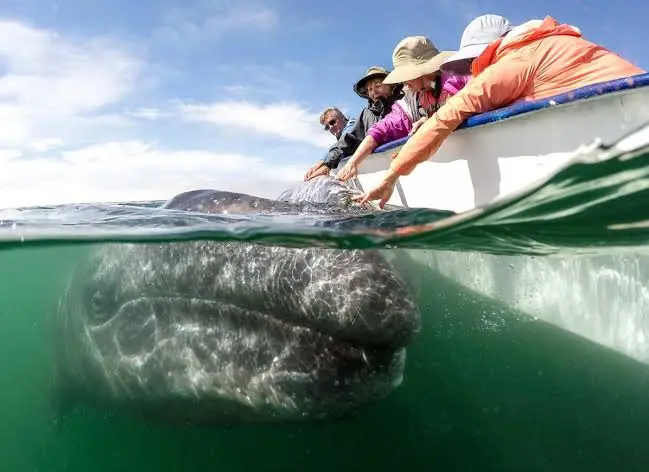
The best whale watching in Baja Mexico, California comes down to two very different experiences on opposite coasts of the peninsula. On the Pacific side, Laguna Ojo de Liebre (Scammon’s Lagoon) is where gray whales come to give birth and nurse their calves close enough to touch from a small boat. On the Gulf side, the Sea of Cortez near Loreto is where blue whales, the largest animals on Earth, gather to feed on krill each winter. Most serious whale watchers eventually want both.
This guide breaks down what each location actually offers, when to go, and how a single trip can combine them.
Which Baja Whale Watching Experience Fits You
| Gray Whale Camp, Laguna Ojo de Liebre | Loreto, Sea of Cortez | |
| Coast | Pacific side | Gulf of California side |
| Primary species | Gray whales, including newborn calves | Blue whales, fin whales, humpbacks, migrating gray whales |
| Peak season | December through April | January through April, best February to March |
| Experience style | Lagoon-side safari camp, multiple close-boat outings | Boat expeditions from a coastal town, resort-style options |
| Signature moment | Mother and calf gray whales approaching the boat | A 100-foot blue whale surfacing beside you |
| Best for | Travelers who want an intimate, remote camp experience | Travelers who want a historic town base and marine biodiversity |
Whale Watching in Baja California: Two Very Different Experiences
Baja California is a single peninsula, but its two coastlines produce entirely different whale watching trips. The Pacific lagoons are shallow, protected nursery grounds where gray whales spend the winter raising their young. The Sea of Cortez, sometimes called Jacques Cousteau’s “Aquarium of the World,” is deep, biodiverse water where blue whales and other large species come to feed. Neither location is a lesser version of the other, they simply offer different animals, different terrain, and a different pace.
Gray Whale Watching at Laguna Ojo de Liebre
Laguna Ojo de Liebre sits inside the Vizcaíno Biosphere Reserve, a UNESCO-protected area on the Pacific side of the peninsula, and it is the closest whale camp to the US border of its kind. Gray whales choose this lagoon specifically to give birth and teach their calves to surface and breathe, which is why encounters here are frequently mother-and-calf pairs rather than solitary adults.
What sets this location apart is proximity. Boats operate within the lagoon itself, and whales, particularly curious calves, often approach close enough for guests to see individual barnacles and scarring. Camp accommodations sit directly on the lagoon shore, close enough that guests report hearing whales breathing overnight.
What the camp includes:
- Safari-style tents with real beds, warm blankets, and robes
- Gas-heated showers and flush toilets
- Three meals a day, including a multi-course dinner featuring regional Baja cuisine
- One to two whale watching boat trips depending on the itinerary
- No single supplement for solo travelers
See the full Gray Whale Watching Baja Camp experience for camp details, amenities, and season dates.
Whale Watching in Loreto, Baja California: Blue Whales and the Sea of Cortez
Loreto is a historic coastal town on the Gulf side of Baja California Sur, positioned beside the Sea of Cortez and the Loreto Bay National Marine Park. Unlike the remote lagoon camp, Loreto offers a town base with an international airport, restaurants, and a range of accommodation from practical lodging to full resorts, alongside boat-based whale expeditions.
What you can see near Loreto, by season:
| Species | Season |
| Blue whales | January to April, peak February to March |
| Fin whales | Possible year-round |
| Humpback whales | December to April |
| Gray whales (migrating through) | January to March |
| Dolphins and sea lions | Frequent, year-round |
Blue whales are the headline draw, animals that can reach roughly 100 feet and 200 tons, feeding on dense krill blooms created by deep-water upwellings in the Sea of Cortez. A single day on the water near Loreto can realistically include blue whales, fin whales, humpbacks, and large dolphin pods in the same outing.
Explore whale watching in Loreto and the Sea of Cortez for season details and tour options.
Best Time to Go: Season Calendar
| Month | Gray Whales (Ojo de Liebre) | Blue Whales (Loreto) |
| December | Season begins | Humpback activity begins |
| January | Strong activity, calving season | Blue whales arrive, gray whales migrating through |
| February | Peak season | Peak blue whale window |
| March | Peak season | Peak blue whale window |
| April | Season winding down | Still productive, then departure |
Should You Do Both? The 10-Day Gray and Blue Whale Combo
Because the two experiences are genuinely different, and only a few hours apart by domestic flight and ground transport, Baja Jones Adventure Travel runs a combined itinerary rather than asking guests to choose one over the other.
10-Day Gray and Blue Whale Combo itinerary:
- Days 1 to 6: Gray whale camp at Laguna Ojo de Liebre, with multiple boat outings
- Days 7 to 9: Blue and fin whale expeditions near Loreto in the Sea of Cortez
- Day 10: Return routing toward San Diego
The published reference price is $5,195 per person, with no single traveler supplement on standard dates, and the trip includes flights and ground transportation logistics, accommodations across every stop, meals, guided whale programs, and marine naturalist support. Guests who prefer more comfort in Loreto can request a resort-style upgrade without missing any whale activity.
View the full 2027 schedule and pricing or book your adventure.
Why Responsible Whale Watching Matters
Close encounters with gray and blue whales are only sustainable if operators follow practices that keep whales undisturbed and unstressed, particularly around mothers and calves in the nursery lagoons. Read our approach to responsible whale watching to understand how encounters are kept safe for both guests and whales, and see the Whale Species and Wildlife guide for more on what you might encounter across both regions.
How to Plan Your Baja Whale Watching Trip
- Decide which experience matters more to you, an intimate lagoon camp with newborn gray whales, a town-based trip centered on blue whales, or both.
- Check the season for your target species, gray whale calving peaks December through April, blue whales peak February through March.
- Book early for peak dates, particularly February and March, since camp and boat capacity is limited by design to keep encounters close and uncrowded.
- Decide on accommodation style, remote safari camp comfort at Ojo de Liebre, or a resort-style upgrade option in Loreto.
- Confirm travel logistics, flights, ground transportation, and any pre- or post-trip time in San Diego if doing the combined itinerary.
Frequently Asked Questions
What is the best place to see whales in Baja California, Mexico?
It depends on which whales you want to see. Laguna Ojo de Liebre on the Pacific side offers the closest gray whale encounters anywhere in Baja, including mothers with newborn calves. Loreto, on the Sea of Cortez side, is the best base for blue whales, the largest animals on Earth.
Is whale watching in Loreto different from gray whale watching in Baja?
Yes. Loreto trips are boat-based expeditions from a coastal town targeting blue whales, fin whales, and humpbacks in the Sea of Cortez. Gray whale watching happens in a shallow Pacific lagoon where whales come specifically to give birth, producing much closer, calmer encounters, often with calves.
When is the best time to see blue whales near Loreto?
Blue whales are typically present from January through April, with the strongest concentration and peak sightings in February and March.
When is the best time to see gray whales in Baja?
Gray whale season generally runs December through April, with peak activity, including newborn calves, from January through March.
Can I see both gray whales and blue whales on one trip to Baja?
Yes. A combined itinerary pairs six days at the gray whale camp on Laguna Ojo de Liebre with three days of blue and fin whale expeditions near Loreto, connected by a short domestic flight and ground transport.
Is Baja whale watching suitable for solo travelers?
Yes. Solo travelers are welcomed at the gray whale camp with no single supplement charged on standard dates.
About Baja Jones Adventure Travel: Led by Keith Jones, who has documented gray and blue whale encounters in Baja California and the Sea of Cortez since the 1990s, Baja Jones Adventure Travel runs the Gray Whale Camp at Laguna Ojo de Liebre and whale watching expeditions near Loreto. Read more about Keith Jones and his decades on the water, or browse expedition stories from the field.
Contact: keith@jonesadventures.com | +1 (626) 512-0877 | Book your adventure