
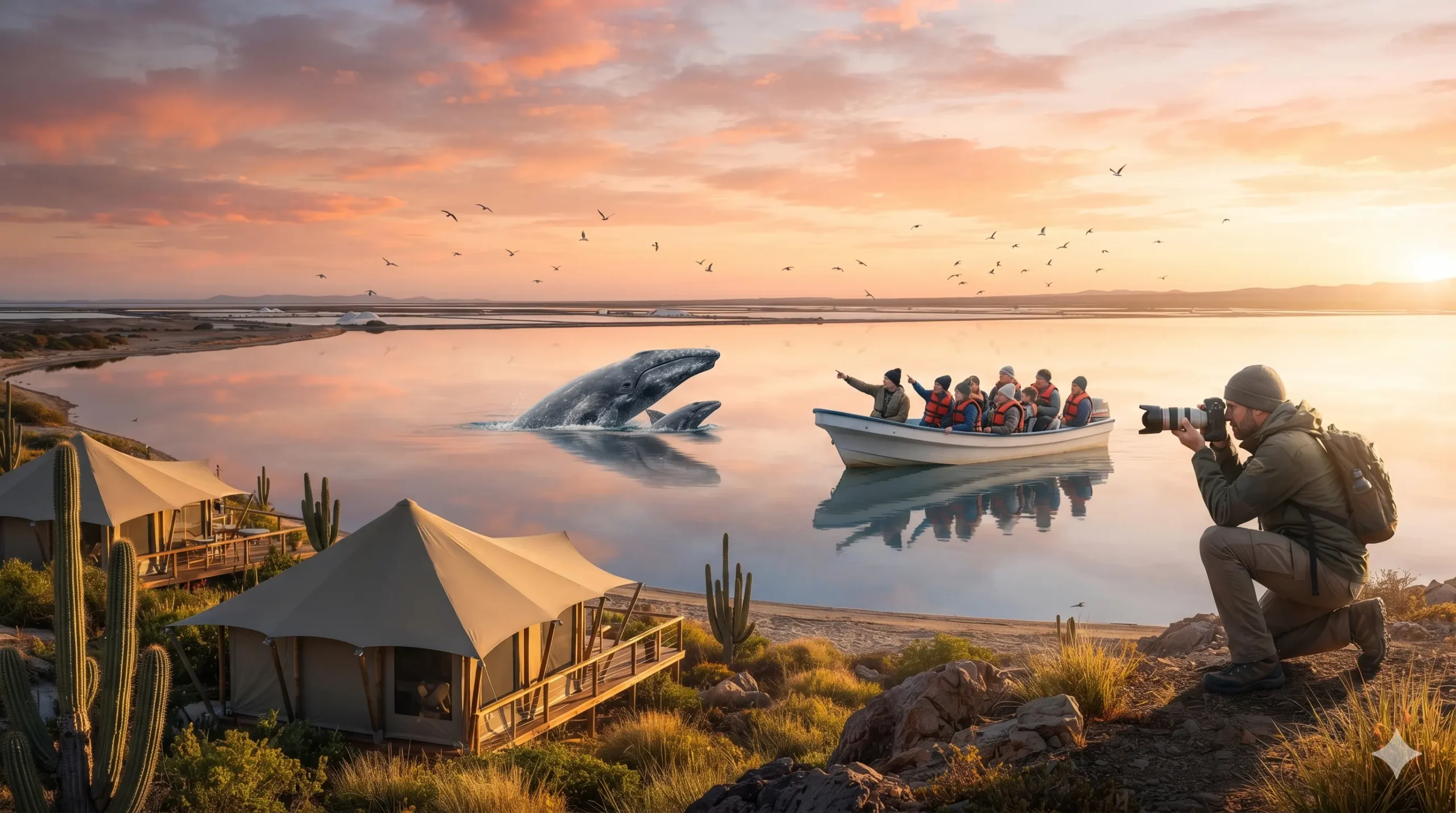
Grey whale watching in Baja happens on three protected Pacific lagoons in Baja California and Baja California Sur, Laguna Ojo de Liebre, San Ignacio Lagoon, and Magdalena Bay, between mid-December and mid-April. A Baja whale watching camp puts you inside that window and beside the water, so you fall asleep hearing whales surface and wake up ready to board a boat within minutes. The rest of this guide covers where to go, when to go, what a camp trip actually involves, and how to choose one.
What Is a Baja Whale Watching Camp?
A Baja whale watching camp is a lagoon-side tented camp, not a hotel in a nearby town. Guests stay in the Vizcaino desert on the shore of the lagoon itself and take small guided boat trips (called pangas) out onto the water, usually twice a day. The alternative, a day tour from Guerrero Negro or La Paz, means driving to and from the lagoon each day and getting one boat trip instead of two.
The camp model exists because the whales are the point. Sleeping beside a gray whale watching camp on Laguna Ojo de Liebre means the first boat trip of the day happens minutes after breakfast, not hours after a highway drive.
Where to Watch Grey Whales in Baja: Comparing the Three Lagoons
All three lagoons sit inside protected waters on the Pacific coast of the Baja California peninsula, but they are not interchangeable. Distance from the open ocean, boat quotas, and whale counts vary by location.
| Lagoon | Location | Typical whale numbers | Boat access | Best known for |
| Laguna Ojo de Liebre (Scammon’s Lagoon) | Baja California, near Guerrero Negro | Highest counts of the three lagoons most seasons | Dock launch, three whale watching zones | Highest concentration of mother and calf pairs |
| San Ignacio Lagoon | Baja California Sur | Fewer whales, one whale watching zone | Wade-out launch from shore | Ecotourism cooperatives, UNESCO-listed lagoon |
| Magdalena Bay | Baja California Sur, near Puerto San Carlos | Lowest counts of the three | Dock or wade-out, depending on operator | Combined with sportfishing and mangrove tours |
Laguna Ojo de Liebre and San Ignacio Lagoon both sit inside the El Vizcaino Biosphere Reserve, a UNESCO World Heritage Site and Mexico’s largest protected natural area at more than 2 million hectares. That protected status is what keeps the whale nursery grounds intact season after season.
Whale counts published on our own 2027 season schedule page, drawn from Mexican government census data, showed Laguna Ojo de Liebre carrying roughly five to ten times the whale numbers recorded at San Ignacio Lagoon on matching survey dates in 2024 and 2025. If your goal is the highest number of whale sightings per boat trip, that gap is worth knowing before you book.
When Is Grey Whale Season in Baja California?
Grey whale season in Baja runs from roughly mid-December through mid-April, tracking one of the longest migrations of any mammal on earth: a round trip of nearly 10,000 miles between the Bering and Chukchi Seas and Baja’s warm lagoons.
| Period | What’s happening in the lagoons |
| Mid-December to late January | First arrivals, mostly pregnant females seeking sheltered water to give birth |
| Early February to mid-March | Peak season. Lagoons fill with nursing mothers, calves, and courting adults |
| Mid-March to mid-April | Numbers thin out, but many guides report the highest rate of close, curious approaches from remaining whales |
That late season pattern shows up directly in our own trip notes. Camp records covering more than a decade of March departures describe fewer whales in the lagoon by mid to late March, but a noticeably higher proportion of friendly, boat-approaching whales among those that remain. If a close encounter matters more to you than a high whale count, the tail end of the season is worth considering. Full pricing and dates are on our 2027 schedule.
A note on population trends
NOAA Fisheries estimated the eastern North Pacific grey whale population at roughly 15,930 to 20,530 whales for the 2025 to 2026 season, an average of about 17,750. That is a rise from the prior year’s estimate near 12,890, following a federally declared unusual mortality event that ran from 2019 to 2023. NOAA researchers note that calf production in 2025 was the lowest on record at 85 calves, so the population’s long-term trajectory is still being studied rather than settled. We link to NOAA’s public data because whale counts change from year to year, and a responsible operator should point you to the source rather than a fixed number.
What to Expect on a Baja Whale Watching Camp Trip
A typical camp itinerary follows a predictable rhythm, whether you book a 4, 5, 6, or 8 day trip:
- Travel day. You meet the group in San Diego, Ensenada, Yuma, or Loreto and travel by ground or short flight to camp.
- Arrival and orientation. Settle into your tent, meet the guide team, and get a briefing on the boats, the lagoon zones, and the day’s schedule.
- Morning boat trip. Boats typically depart around 7 to 9 am for a one to two hour outing on the lagoon.
- Meals in camp. Breakfast and lunch are café style, dinner is a multi-course meal built around regional Baja ingredients.
- Afternoon boat trip. A second outing, weather permitting, often in different light and different whale activity than the morning.
- Evening in camp. Desert quiet, star-filled skies, and the sound of whales surfacing near shore through the night.
- Departure day. Return travel to your starting point.
Weather can delay or cancel an individual boat trip, which is why trips of five days or longer (three to four whale watching days) give more of a buffer than a four day trip. For a full look at camp facilities, meals, and tent setups, see the Gray Whale Watching Baja Camp page.
Why Grey Whales Approach Boats in Baja Lagoons
Grey whales in Ojo de Liebre and San Ignacio are known for a behavior rarely documented in other whale species anywhere in the world: voluntarily approaching small boats, sometimes bringing a calf directly alongside to be touched. Researchers first recorded this “friendly whale” behavior in the lagoons in the 1970s, decades after commercial whaling had ended in the same waters, and it has continued in a portion of the population every season since.
The leading explanation is that it is a learned behavior, passed from mother to calf within the lagoon population rather than an instinct common to grey whales as a species. Our own guide team has documented this firsthand for decades. You can read more on the whale species and wildlife page, including notes on breaching behavior, mother and calf interactions, and the other cetaceans that share these waters, from blue whales to orcas.
Responsible Whale Watching: The Rules That Protect the Lagoons
Boats operating in the Baja whale lagoons work under Mexican federal regulation NOM-131-SEMARNAT-2010, adapted further for the El Vizcaino Biosphere Reserve’s management plan. Key rules include:
- Licensed, flagged operators only, with a visible permit displayed on the vessel
- A 5 knot speed limit near whales, dropping to 2 knots inside an observation zone
- A maximum of two boats per whale or whale group at a time
- An 80 meter waiting distance for additional boats wanting to observe the same whales
- Protected refuge zones inside the lagoons where no boats are permitted at all
These rules exist because the lagoons are breeding and nursery habitat, not open water. A whale that chooses to approach a boat is behaving on its own terms, and a responsible operator never chases, crowds, or forces an encounter. Our full approach to this is laid out on the responsible whale watching page, including a firsthand account of why strict boat discipline matters.
How to Choose a Baja Whale Watching Camp
Not every operator running trips into the lagoons offers the same experience. Before booking, check for these points:
- Lagoon location. Ask which lagoon you will be based on and how many boats are permitted in that zone.
- Boat launch method. Some camps use a dock, others require wading out through mud and shallow water to board.
- Years of operation. A camp with decades of consistent seasons has a track record of weather handling and whale encounters you can ask about directly.
- Group size and boat quotas. Fewer boats per zone generally means calmer water and closer whale encounters.
- What’s included. Confirm meals, tent quality, number of boat trips per day, and transport options are stated clearly before you pay a deposit.
- Solo traveler policy. Ask directly whether solo travelers pay a single supplement or share a tent by default.
Our own camp has operated seasonally inside the Vizcaino Biosphere Reserve for more than 30 years under founder Keith Jones, who has personally guided the gray whale migration season every year since 1994. Full trip lengths, dates, and pricing for the 2027 season are posted on the schedule page.
Beyond Grey Whales: Extending a Baja Trip
Grey whales are not the only reason to build a Baja itinerary around whale watching. Blue whales, the largest animals ever known to have lived on earth, winter in the Sea of Cortez near Loreto, roughly 10 to 20 adults tracked most seasons. Travelers looking to combine both species in one trip can review the blue whale expeditions page or the whale watching Loreto page, and general trip planning for the peninsula is covered in the Baja California guide. Photos from past seasons, including close boat encounters and camp life, are in the gallery.
Frequently Asked Questions
Where is the best place to watch grey whales in Baja?
Laguna Ojo de Liebre, San Ignacio Lagoon, and Magdalena Bay are the three protected lagoons where grey whales gather each winter. Ojo de Liebre generally carries the largest whale numbers and hosts the most whale watching zones of the three.
When is grey whale season in Baja California?
Roughly mid-December through mid-April. The first pregnant females arrive in late December, the lagoons peak in activity from February through mid-March, and the season winds down by mid-April.
What is a Baja whale watching camp?
A tented camp on the shore of a whale lagoon, where guests sleep near the water and board boats directly from camp, rather than commuting from a hotel in a nearby town for a single day tour.
Why do grey whales approach boats in Baja lagoons?
This voluntary, curious behavior has been documented in Ojo de Liebre and San Ignacio since the 1970s. It appears to be a learned behavior within the lagoon population rather than a trait seen in grey whales generally, and researchers believe it is passed from mother to calf.
Is whale watching in Baja regulated?
Yes. Mexican federal regulation NOM-131-SEMARNAT-2010 sets speed limits, approach distances, and boat quotas per whale group, with additional protections tied to the El Vizcaino Biosphere Reserve.
How many days should I spend at a grey whale camp?
Most trips run 4 to 8 days with two boat outings per whale watching day. A 5 or 6 day trip (three to four whale watching days) allows for a weather delay without losing an outing entirely.
Plan Your Baja Whale Watching Trip
The 2027 season is open for booking now, with trip dates running from late January through late March. Review full pricing and dates on the 2027 schedule, or contact our team directly at keith@jonesadventures.com or +1 (626) 512-0877 to match your travel window to the right lagoon and trip length.