
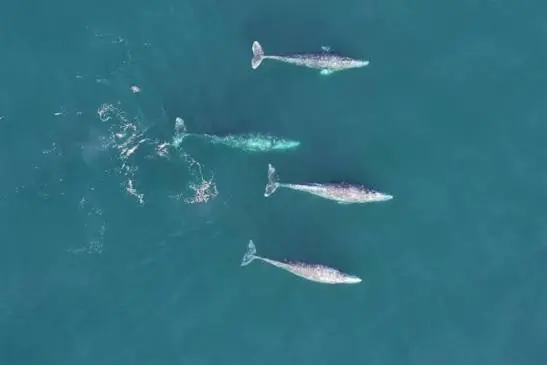
Quick answer: NOAA’s newest survey estimates roughly 17,750 Eastern North Pacific gray whales (a range of 15,930 to 20,530), up from about 12,890 in 2025, which was the lowest count since systematic surveys began in the late 1960s. Scientists studying the data caution the jump likely reflects a mix of real recovery and year-to-year counting variability, not a clean rebound story, and they flag a separate concern: only 85 gray whale calves were recorded in 2025, the fewest on record. For anyone planning a Baja California whale watching trip, the short version is that gray whales are still reliably migrating to the lagoons each winter, but the population remains sensitive enough that how you watch them now matters as much as when.
If you’ve seen headlines this year about gray whale numbers rising, it’s worth understanding what the data actually shows before you book a trip, or decide the whales are “back to normal.” They’re not quite there yet, and the details matter for anyone heading to Baja California to see them in the lagoons this season.
What NOAA’s New Count Actually Found
| Survey year | Estimated population | Notes |
| 2025 | ~12,890 (range 11,690 to 13,190) | Lowest count since surveys began in the late 1960s |
| 2026 | ~17,750 (range 15,930 to 20,530) | Sharp year-over-year increase |
On the surface, a jump of roughly 5,000 whales in one year looks like unambiguous good news. NOAA’s own researchers are more careful about that reading, and the reasons why are worth understanding.
Why the Number Jumped: Recovery, or Just Better Counting?
Gray whale researcher Aimee Lang put it directly: the increase raises the question of “whether we see a consistent proportion of the population every year, or whether other factors affect how much of the population we see and count.” In plain terms, gray whale surveys count whales as they migrate past fixed points on the California coast, and how many whales get spotted in a given year depends on ocean conditions, migration timing and survey visibility, not just how many whales exist.
NOAA also noted that the size of the increase “likely exceeds the reproductive capacity of the population,” meaning gray whales simply can’t biologically reproduce fast enough to explain the full jump in one year. That points toward a combination of real population recovery and a undercount in the unusually low 2025 survey, rather than a single clean explanation.
The Other Number That Matters: Only 85 Calves in 2025
The population estimate isn’t the only figure researchers are watching. In 2025, only 85 gray whale calves were recorded, the lowest calf count since tracking began. Low calf numbers are typically linked to conditions in the Arctic feeding grounds gray whales rely on before their migration south, since a poor feeding season leaves less energy for successful pregnancies and calf survival.
NOAA researchers have also pointed out a broader pattern worth keeping in mind: populations considered recovered or close to recovery, like Eastern North Pacific gray whales, tend to be the first to show climate-related downturns, precisely because they’re already living close to what their environment can support.
What This Means If You’re Planning a Whale Watching Trip to Baja
None of this changes the basic migration pattern that makes Baja California one of the most reliable places on earth to see gray whales up close. Gray whales still travel roughly 10,000 miles round trip each year between Arctic feeding grounds and the calm, shallow lagoons of Baja California, where they calve and nurse from around January through early April. That migration hasn’t stopped, and the lagoons remain the most consistent viewing window anywhere in their range.
What it does mean is that population health is more fragile than a single “numbers are up” headline suggests, which is exactly why the timing and structure of your trip is worth planning around the current 2027 season schedule rather than assuming any week in the season is equivalent.
Why Responsible Whale Watching Matters More When Populations Are Sensitive
When a population is still stabilizing after a record low, how whale watching operators behave around the whales has a real impact, not just an ethical one. Boat speed, group size, and how closely and how long boats approach a mother and calf all affect stress levels for animals that are already navigating a challenging recovery period. This is the reasoning behind responsible whale watching practices: fewer, better-managed encounters do less cumulative harm to a population than high-volume tourism does, especially in a year when the data shows the recovery isn’t fully secure yet.
Frequently Asked Questions
Are gray whales endangered in 2026?
No. Eastern North Pacific gray whales were delisted from the Endangered Species Act in 1994 after recovering from historical whaling. They are not currently classified as endangered, though NOAA’s 2025-2026 data shows the population is more sensitive to environmental conditions than a simple “recovered” label suggests.
Why did the gray whale count jump so much in one year?
NOAA researchers attribute the increase to a combination of genuine population recovery and normal year-to-year variability in how many whales are detected during migration surveys. They’ve stated the full size of the jump is larger than the population’s biological reproduction rate could explain on its own.
Is it still a good time to go gray whale watching in Baja?
Yes. The migration to Baja’s lagoons is an annual pattern that continues regardless of year-to-year population count fluctuations. The main planning consideration is timing your trip within the January through early April window when whales are present in the lagoons in the greatest numbers.
What caused the record-low calf count in 2025?
Researchers link low calf numbers to conditions in the Arctic feeding grounds gray whales depend on before migrating south. A poor feeding season can reduce the energy reserves needed for successful pregnancy and calf survival the following year.
Does a smaller whale watching group make a real difference to the whales?
Yes. Reduced boat speed, smaller group sizes and limited approach time around whales, particularly mothers with calves, are widely supported practices for lowering stress on animals during a sensitive recovery period.
Curious to see this season’s gray whales for yourself, in a way that respects where their population actually stands? Get in touch to plan your trip and we’ll walk you through the current season’s dates and lagoon options.