
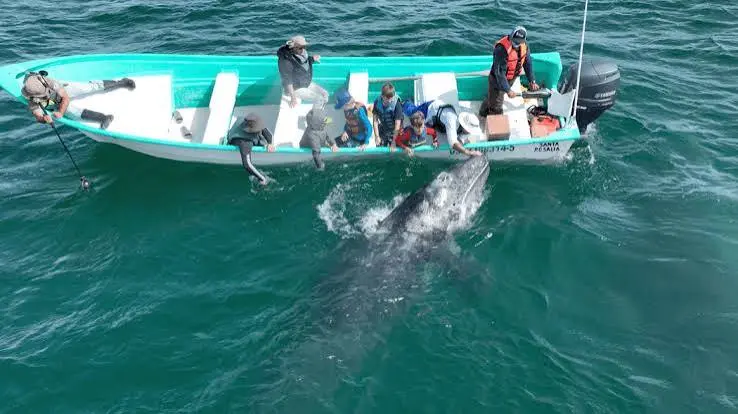
In a handful of lagoons along the Baja California coast, gray whales, especially mothers with calves, sometimes swim directly up to small boats, linger beside them, and appear to invite people to touch them. This is not something guides train the whales to do or provoke with bait. By every account from the people who spend entire seasons on the water, the whale makes the choice to approach, not the other way around. It is one of the only documented cases anywhere in the world of a wild whale species reliably initiating contact with humans, and it’s a large part of why a gray whale watching camp in Baja California sits on these specific lagoons rather than simply anywhere gray whales pass through.
What “Friendly Whale” Behavior Actually Looks Like
The behavior isn’t a single trick, it shows up in a few recognisable ways on the water:
- A mother positioning her calf directly alongside or under a boat
- Whales spy-hopping (lifting their head vertically out of the water) right next to a vessel
- Calves nudging or rubbing against the hull
- Whales allowing people to touch their head, back, or baleen without pulling away
- Whales returning to the same boat repeatedly during a single outing
None of this happens on command. Guides describe it as something you wait for and respond to, not something you can reliably trigger on any given day.
Where This Happens in Baja California
This behavior is specific to a small number of sheltered breeding and calving lagoons on the Pacific side of the Baja peninsula, where gray whales spend the winter months before migrating north.
| Lagoon | Location | Known For |
| Laguna Ojo de Liebre (Scammon’s Lagoon) | Vizcaíno Biosphere Reserve, central Baja | The lagoon where this camp is based, high density of mothers and calves |
| San Ignacio Lagoon | South of Ojo de Liebre | Widely credited as where whale-initiated contact was first documented and studied |
| Magdalena Bay | Southern Baja California Sur | Also sees friendly whale encounters, though generally later in the season |
These lagoons share the same basic conditions: shallow, calm, and largely free of predators, which is exactly why gray whales use them to give birth and raise young calves in the first place.
From Hunted to Curious: A Genuinely Unusual Shift
For context, this same stretch of coastline was once the center of an intensive 19th and 20th century whaling industry. Gray whales earned a reputation among whalers as fiercely protective and dangerous when their calves were threatened, which is part of where the old nickname “devil fish” came from. For decades, the expected relationship between gray whales and small boats in these lagoons was fear and defense, not curiosity.
The shift toward whales voluntarily approaching boats is generally described as having emerged in these lagoons starting in the 1970s, after commercial whaling in the area had ended and the population had time to recover. It remains one of the more remarkable documented changes in how a wild population has come to treat humans over a single generation or two, and it’s still closely watched by researchers and guides operating in the lagoons today.
Why Scientists Think This Happens
There is no single, fully settled explanation, and it’s worth being honest about that rather than overstating certainty. A few explanations come up most often among marine biologists and long-time guides:
- A safe, predator-free nursery. These lagoons are calm and free of orcas, which may make mothers more relaxed around boats than they would be in open water.
- Curiosity in calves. Young whales are generally more investigative than adults, and mothers appear to tolerate or even encourage that curiosity in a low-risk environment.
- Learned, generational behavior. Some researchers suggest that calves that experience calm human interaction may carry that comfort into adulthood, reinforcing the pattern over time.
- Absence of hunting pressure. With no whaling in these lagoons for decades, whales no longer have a reason to associate boats with danger.
Most likely, it’s some combination of all of the above rather than one single cause.
Is It Safe, and Is It Ethical?
This is the right question to ask before booking any trip built around this experience. Reputable operators follow a simple rule: the whale decides, not the boat. That means guides keep engines idle or off and let the whale choose whether to approach, rather than chasing, cornering, or baiting an animal to get closer. Baja’s whale lagoons are also protected biosphere reserves, and boats operating there need permits and are expected to follow specific approach distances and conduct rules.
If you’re evaluating operators for a whale watching trip, it’s worth reading through responsible whale watching guidelines so you know what ethical practice actually looks like on the water, and can tell the difference between an operator who waits for the whale and one who doesn’t.
What This Means If You’re Planning a Whale Watching Trip
A few honest expectations, rather than a guarantee:
- Friendly whale encounters are common during peak season (roughly January through March) but are not promised on every single outing.
- Encounters are typically more frequent later in the season, once more calves have been born and had time to grow more confident.
- Multi-day camps generally see more of this behavior than a single short outing simply because there are more chances for it to happen.
- Every encounter is initiated by the whale. Guides can position a boat calmly and patiently, but they cannot make a whale approach.
If you want to understand more about gray whale behavior beyond this specific phenomenon, including migration patterns and other species you may see in the same waters, our gray whale species and behavior page goes into more depth.
Frequently Asked Questions
Do gray whales really approach boats on purpose?
Yes, this is well documented in specific Baja California lagoons, particularly among mothers with calves. Guides and researchers consistently describe it as whale-initiated, not something boats can reliably provoke or force.
Is it safe to touch a gray whale?
When it happens on the whale’s own terms, in a calm, low-speed setting with an experienced guide, it is considered safe and is a well-established part of responsible whale watching in these lagoons. It is not safe or appropriate to reach for, chase, or touch a whale that has not approached voluntarily.
Where in Baja can you see friendly gray whales?
The behavior is concentrated in a small number of lagoons: Laguna Ojo de Liebre (Scammon’s Lagoon), San Ignacio Lagoon, and Magdalena Bay. Each has slightly different timing and conditions within the same winter season.
Do all gray whales behave this way, or just some?
No. Not every whale in the lagoon approaches boats, and behavior varies between individuals and even day to day. Mothers with calves are the most commonly involved, but there is no guarantee any specific whale will choose to interact.
When is the best time to see this behavior?
Peak season generally runs from January through March, with encounters typically becoming more frequent as the season progresses and more calves are born and gain confidence in the lagoon.
Is it legal and ethical to interact with wild whales like this?
Yes, when operators hold the correct permits and follow approach guidelines set for these protected biosphere reserves, and when the interaction is initiated by the whale rather than forced by the boat. This is why the choice of operator matters as much as the choice of season.
Final Thoughts
The friendly whale behavior seen in Baja’s lagoons is rare enough, and strange enough, that it’s easy to understand why it draws people back year after year. It’s also easy to misunderstand, treating it as something you can simply book and expect on demand rather than something a wild animal chooses to offer. Understanding the history and the science behind it makes the moment mean more if and when it happens. If you’d like to know what a season currently looks like or have questions before booking, get in touch and we can walk you through it.