
Meet the Gray Whales of Baja: 12 Facts That Make Them Extraordinary
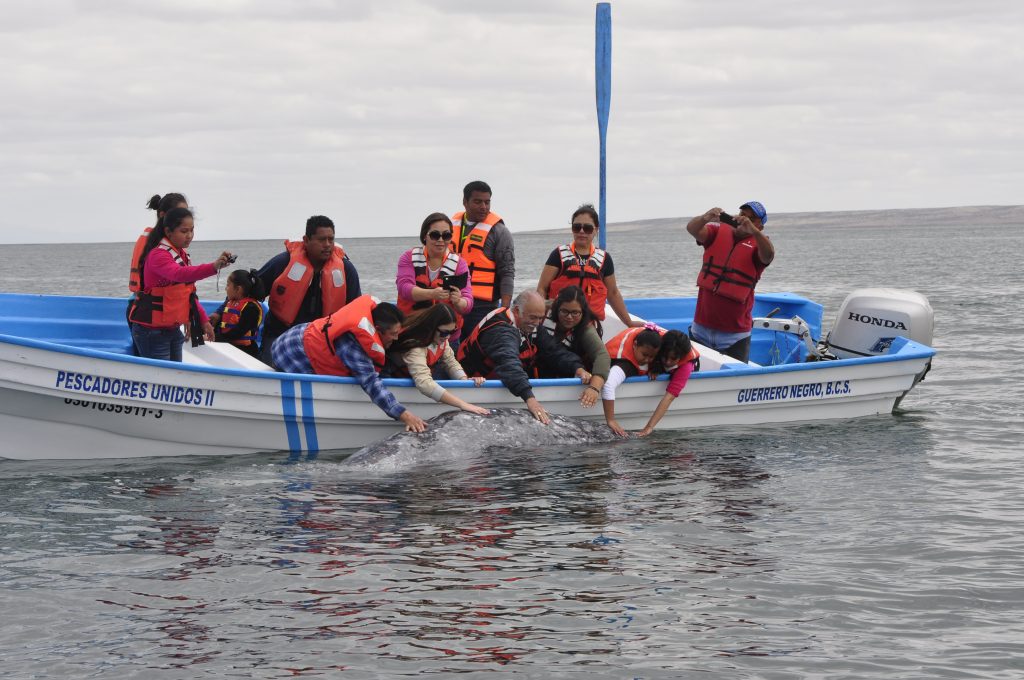
In short: Gray whales travel from Arctic feeding grounds to the warm lagoons of Baja California Sur each winter to give birth and mate. The round trip is roughly 16,000 to 20,000 km (10,000 to 12,000 miles), one of the longest migrations of any mammal. In the lagoons, some mothers and calves show curiosity toward boats. Gray Whale Camp is based at Laguna Ojo de Liebre, one of the main breeding lagoons. Here are 12 facts worth knowing before your trip.
Gray Whale Quick Profile
Trait | Detail |
Scientific name | Eschrichtius robustus |
Adult length | Up to about 14 to 15 m (45 to 49 ft) |
Adult weight | Up to about 36 tonnes (40 tons) |
Length at birth | About 4.5 m (15 ft) |
Diet | Small bottom-dwelling crustaceans such as amphipods |
General Baja lagoon season | About mid-January to mid-April |
12 Facts About Gray Whales in Baja
- They make one of the longest migrations on Earth.Each year they swim from the Bering, Chukchi and Beaufort Seas down the Pacific coast to Baja, then back again.
- They eat very little in Baja.Gray whales build up fat reserves in Arctic waters and rely largely on those reserves during migration and breeding.
- They are bottom feeders.Unlike most baleen whales, gray whales roll onto their side and suck up sediment from the seafloor, filtering out tiny crustaceans.
- The lagoons are natural nurseries.Shallow, protected lagoon water offers calves a calmer start, away from open-ocean predators such as orcas.
- Calves grow fast.Calves drink very rich milk and put on weight quickly before the long swim north.
- Mothers are often the last to leave.Whales without calves usually head north first, while mothers and calves tend to stay longer.
- Their skin tells a story.The mottled pattern comes from barnacles, whale lice and scars. Each pattern is unique, which helps researchers identify individuals.
- Whalers once called them “devil fish.”In the 1800s, mothers defended their calves against whaling boats in these lagoons. Laguna Ojo de Liebre is still often called Scammon’s Lagoon, after the whaling captain who hunted there.
- The friendly behavior was first recorded in 1972.In Laguna San Ignacio, a gray whale approached a fisherman’s panga and allowed him to touch it. Similar behavior has since been seen in other lagoons.
- They recovered, then hit trouble.After protection from commercial whaling, the eastern population was removed from the U.S. Endangered Species List in 1994. NOAA Fisheries later declared an Unusual Mortality Event in 2019, and surveys show a significant decline since 2016.
- The lagoons are a World Heritage Site.The Whale Sanctuary of El Vizcaíno, which includes Ojo de Liebre and San Ignacio, was listed by UNESCO in 1993.
- Spy-hopping is how they look around.When a whale rises vertically with its head above water, it is taking a look at its surroundings, sometimes including nearby boats.
Gray or Grey? A Quick Spelling Note
Both are correct. “Gray whale” is the standard American spelling and the official common name. “Grey whale” is the British and Canadian spelling. If you searched for grey whale watching in Baja, you are in the right place.
How to Watch Gray Whales Responsibly
- Let the whale approach; never chase it or block its path
- Keep hands inside the boat unless a whale comes alongside and your captain says it is appropriate
- Never touch the blowhole or eyes
- Keep noise low so mothers stay relaxed
- Follow your captain’s instructions and the lagoon zone rules at all times
See Them for Yourself
Curious what a whale-watching day looks like at Gray Whale Camp? Read about a typical day at our camp, then check the month-by-month season guide. For current trip dates, see our Schedule page.
Frequently Asked Questions
To give birth and mate in warm, shallow, protected lagoons.
Adults reach about 14 to 15 m and up to about 36 tonnes. Newborns are around 4.5 m.
The eastern North Pacific population is not listed as endangered, but it has declined since 2016. The western population is critically endangered.
No one knows for sure. Curiosity and the sheltered lagoon setting are thought to play a role.
No. Approaches depend on the whales' behavior and on conditions, and they are never guaranteed.