
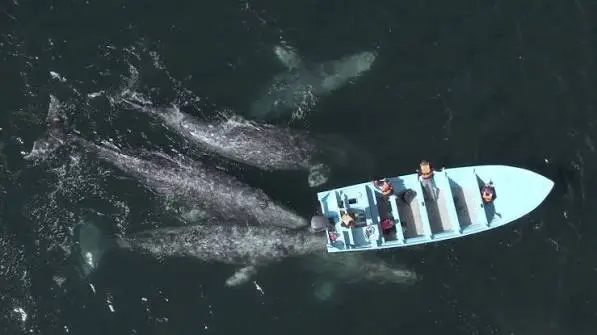
The best gray whale watching trips to Baja run from December through April, with the peak season for close mother and calf encounters falling between January and March. Gray whales travel to three protected lagoons on the Pacific side of the Baja California peninsula to breed and give birth after one of the longest migrations of any mammal on Earth. This guide covers when to go, which lagoon to choose, what a whale watching tour actually involves, and how a lagoon side camp compares to a single day boat trip.
Key takeaways
- Gray whales migrate roughly 10,000 to 12,000 miles round trip each year between Arctic feeding grounds and Baja’s breeding lagoons.
- Three lagoons host the whales: Laguna San Ignacio, Ojo de Liebre (Scammon’s Lagoon), and Bahia Magdalena.
- Peak season for calves and close encounters is January through March, inside a broader December to April season.
- These lagoons are famous for “friendly whale” behavior, where a whale voluntarily approaches a small boat, first documented here in the early 1970s.
- Boat access is limited by conservation permits, so popular season dates can book out months in advance.
Why Gray Whales Come to Baja
Eastern North Pacific gray whales spend their summers feeding in the Bering and Chukchi Seas off Alaska, then travel south along the Pacific coast to reach the warm, shallow lagoons of Baja California, Mexico. It is one of the longest annual migrations of any mammal, and the destination is specific: these lagoons offer calm, predator sheltered water where pregnant females can give birth and young calves can build strength before the long swim north.
The lagoons carry real history. Ojo de Liebre is named after 19th century whaler Charles Scammon, who hunted gray whales here so intensively that the population was pushed to the edge of extinction. Decades of protection since then have allowed the population to recover, and the same lagoons are now internationally recognized breeding sanctuaries inside the Vizcaino Biosphere Reserve.
Adult gray whales typically run 40 to 45 feet long, with a mottled gray body covered in patches of barnacles and whale lice that give each individual a slightly different pattern, useful for researchers who track specific whales across seasons and years. Unlike whales that spend their lives in deep open water, gray whales are bottom feeders, sifting sediment for small crustaceans in the Arctic, which is part of why they tolerate the shallow, muddy lagoon water so well during calving season.
Where to See Them: The Three Baja Lagoons
| Lagoon | Known for | Access |
| Ojo de Liebre (Scammon’s Lagoon) | Largest lagoon, high whale density, closest to the US border | Reached by road through Guerrero Negro |
| Laguna San Ignacio | Calm water, long running record of close encounters | Remote, typically reached via San Ignacio town |
| Bahia Magdalena | Larger bay with wider boat range and mangrove scenery | Reached via Puerto San Carlos or Puerto Adolfo Lopez Mateos |
The Best Time for a Whale Watching Trip
| Month | What to expect |
| December | First whales arrive, season opens, numbers still building |
| January to February | Numbers rise quickly, first calves born, water still cool |
| Late February to March | Peak season, highest concentration of mothers and calves |
| April | Whales begin heading north, season winds down |
Exact dates shift slightly year to year based on when the whales arrive and depart, so check the current season schedule and dates before locking in travel plans.
How to Get to the Lagoons
Most international travelers reach the Baja lagoons in one of two ways. The first is a road trip down the Baja California peninsula, typically starting from San Diego or Tijuana and driving south on Mexico’s Highway 1, which is the more common route for the northern lagoons like Ojo de Liebre near Guerrero Negro. The drive takes roughly a full day depending on the exact lagoon and border wait times, so many trips build in an overnight stop along the way.
The second option is flying into a Baja airport such as Loreto or La Paz and connecting by ground transport from there, which cuts travel time for visitors coming from farther away or who would rather not drive through the peninsula. Because the lagoons themselves are remote, most operators handle the final leg of transport, whether that means arranging a shuttle from a nearby town or coordinating pickup from a regional airstrip, so it is worth confirming exactly what is included before booking flights separately.
What a Whale Watching Tour Actually Looks Like
Most lagoon tours use small, flat bottomed boats called pangas, holding roughly six to ten passengers plus a local guide who has often worked the same waters for years. The guide reads whale behavior and positions the boat, then the rest is up to the whales. Some outings bring several close passes. Others are quieter. That variability is normal in a wild encounter and part of why multi day trips generally outperform a single outing for the chance of a standout moment.
The signature experience these lagoons are known for is the “friendly whale,” a gray whale, usually a mother with her calf, that closes the distance to a boat on its own and sometimes surfaces close enough to touch. It was first documented here in the early 1970s and remains one of the few places on Earth where a wild baleen whale regularly initiates contact with people rather than the reverse.
Camp vs Day-Trip Tours: Which Whale Watching Trip Fits You
| Trip type | Best for | Trade off |
| Lagoon side camp, multiple nights | Travelers who want the best odds of a strong encounter and a full immersion trip | Requires more travel days and advance booking |
| Single day boat tour | Travelers with limited time who want one outing near a Baja town | One shot at a good encounter, more dependent on that day’s conditions |
An overnight, lagoon side setup like the gray whale watching camp in Baja spreads your trip across multiple boat excursions instead of one, which is the main reason multi day camps tend to produce more memorable encounters than a single day tour squeezed into a longer road trip.
What to Pack and Expect
- Layered clothing: lagoon mornings are cool, midday sun is strong, and boats sit low to the water with sea spray.
- Polarized sunglasses and reef safe sunscreen for full days on open water.
- A waterproof bag or case for phones and cameras, since pangas ride close to the waterline.
- Realistic expectations: encounters are wildlife led, and no guide can guarantee a touch distance approach on any single outing.
- Basic Spanish phrases are helpful but not essential, since most operators run English speaking guided trips for international visitors.
Responsible Whale Watching: Why the Rules Matter
These lagoons are protected biosphere reserves, and access is deliberately limited to keep the whales’ breeding and nursing behavior undisturbed. Licensed operators work under time limits around whale groups, designated refuge zones where boats cannot go, and controlled approach rules, so the whale decides how close it comes rather than the boat forcing the interaction. Choosing an operator that follows responsible whale watching practices protects both the animals and the long term future of the encounter that makes these lagoons worth visiting in the first place.
Frequently Asked Questions
When is the best time for a gray whale watching trip in Baja?
Gray whales are in the Baja lagoons from December through April, with the peak concentration of whales, including newborn calves, from January through March. Late February into March is often the strongest window for close mother and calf encounters.
Which Baja lagoon is best for whale watching tours?
Laguna San Ignacio, Ojo de Liebre (Scammon’s Lagoon), and Bahia Magdalena all host gray whales, and all three are protected breeding and calving areas. Ojo de Liebre is the largest lagoon and closest to the US border, while San Ignacio is prized for calm water and a long history of close whale encounters.
What is a friendly whale encounter?
A friendly whale encounter is when a gray whale, usually a mother with her calf, voluntarily approaches a small boat close enough to touch, a behavior first documented in these lagoons in the early 1970s. It happens entirely on the whale’s initiative and cannot be forced or guaranteed on any single outing.
Is a camp based whale watching trip better than a day boat tour?
A camp based trip stays lagoon side overnight and typically includes multiple boat excursions across several days, which raises the odds of a strong encounter compared to a single day trip from a distant town. A day tour works better for travelers with limited time who mainly want one outing rather than a multi day stay.
How far in advance should I book a gray whale watching tour?
Peak season dates, especially weekends in February and March, tend to fill months ahead because lagoon access is limited by conservation permits and boat quotas. Booking as soon as your season dates are set gives you the widest choice of dates and accommodations.
Are gray whale watching trips regulated to protect the whales?
Yes. The lagoons sit inside protected biosphere reserves where licensed operators follow time limits around whale groups, designated refuge zones boats cannot enter, and controlled approach rules so encounters happen on the whales’ terms rather than through aggressive boat handling.
Ready to plan your season? Book your spot for the current season before the best dates are gone.