
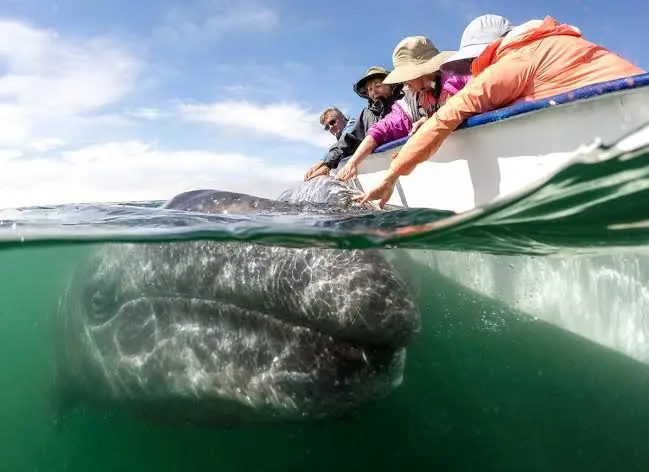
Short answer: gray whales arrive in Baja California’s Pacific lagoons from late December, peak through February and March, and have mostly departed by mid-April. The three main lagoons are Laguna Ojo de Liebre, Laguna San Ignacio, and Bahía Magdalena. February and March are the strongest weeks because that is when mothers and calves are present and calves are old enough to be curious about boats. Encounters are never guaranteed, and honest operators say so.
If you are planning a trip around whales rather than fitting whales into a trip, this covers the timing, the lagoon choice, and the things that decide whether you get a good week or a quiet one.
Why Baja, and why these lagoons
Eastern North Pacific gray whales make one of the longest migrations of any mammal, traveling roughly 10,000 to 12,000 miles round trip each year between Arctic feeding grounds in the Bering and Chukchi Seas and the lagoons of Baja California.
They come for a specific reason. The lagoons are shallow, sheltered, warm and salty, which makes them unusually safe places to give birth and nurse a calf through its first weeks. Orcas, the main predator of gray whale calves, rarely enter them.
Two of the lagoons sit inside the El Vizcaíno Biosphere Reserve, recognized by UNESCO as the Whale Sanctuary of El Vizcaíno. That protection is the reason the experience still exists in a recognizable form, and it is why access is regulated rather than open.
When to go: month by month
| Period | What is happening | Worth booking? |
| Late December | First arrivals, mostly pregnant females and adults | Early and unpredictable |
| January | Numbers build, births begin | Good, fewer people |
| February | Peak season, mothers and newborn calves in the lagoon | Strongest weeks |
| March | Peak continues, calves larger and more active | Strongest weeks |
| Early April | Northbound departure underway, numbers thinning | Late but possible |
| Mid-April onward | Lagoons largely empty | No |
The northward migration begins around mid-February and is staggered by age and reproductive condition. Newly pregnant females leave first. Mothers with calves leave last, which is why late February and March consistently give the best combination of numbers and behavior. A calf needs a few weeks before it is strong and curious enough to approach a boat.
Trips are sold by the week and the good weeks sell out well ahead, so if a specific window matters to you, check the season schedule and dates early rather than close to the season.
Which lagoon: the three options compared
| Laguna Ojo de Liebre | Laguna San Ignacio | Bahía Magdalena | |
| Also known as | Scammon’s Lagoon | San Ignacio Lagoon | Mag Bay |
| Nearest town | Guerrero Negro | San Ignacio | Puerto San Carlos, López Mateos |
| Protection | Vizcaíno Biosphere Reserve | Vizcaíno Biosphere Reserve | Not within the reserve |
| Access | Paved road, straightforward | Long unpaved approach | Paved, closest to La Paz and Loreto |
| Typical trip style | Shore camps and day boats | Remote eco-camps | Day trips from town |
| Character | Largest lagoon, historically high whale numbers | Famous for friendly whale behavior, remote | Easiest to combine with other Baja travel |
How to choose. Magdalena Bay suits travelers combining whales with a wider Baja itinerary. San Ignacio suits people who want remoteness and accept a rough drive to get it. Ojo de Liebre suits those who want the largest lagoon with straightforward access, and it is the practical choice for a multi-day shore-based stay.
What a “close encounter” actually means
Baja’s reputation rests on something genuinely unusual: gray whales here sometimes approach small boats deliberately. Mothers occasionally bring calves alongside. The behavior was first recorded at San Ignacio in the early 1970s and has been documented across the lagoons since.
Some honest framing matters here.
The whale decides. Boats do not chase, herd, or pursue. They position and wait. A friendly encounter happens because a whale chose to investigate, which is exactly why it is remarkable and exactly why it cannot be promised.
Calves are the curious ones. Adults are usually indifferent. Juveniles and calves investigate. This is another reason February and March outperform January.
Time on the water is the variable you control. A single two-hour boat trip is one roll of the dice. Several days of multiple outings changes the odds substantially. That is the entire argument for a lagoon-side stay over a day trip, and it is a probability argument rather than a luxury one.
Nobody can guarantee it. Any operator promising guaranteed close contact is selling something they do not control.
The difference between watching whales from a distance and having one surface beside the boat is mostly a function of days on the water, which is why the lagoon camp format exists at all.
An honest note on whale numbers
This section will not appear on most whale watching websites, and it should.
The eastern North Pacific gray whale population is under real pressure. NOAA Fisheries recorded a peak of roughly 27,000 whales around 2016, then declared an Unusual Mortality Event that ran from 2019 to 2023. Abundance estimates fell to a low of approximately 11,700 to 14,200 whales in the 2024/2025 count, before an apparent increase to roughly 15,930 to 20,530 in the 2025/2026 count.
Reproduction remains the concern. Calf production has stayed at historically low levels, and the 2025 estimate of northbound calves was the lowest in a count series that began in 1994. Researchers link the decline substantially to shifting prey availability in the Arctic. Strandings rose again through 2026, and as of mid-2026 NOAA had not declared a new mortality event, while noting that levels resembled the earlier crisis.
What this means for planning a trip. Numbers in the lagoons vary year to year and lagoon to lagoon, and recent seasons have been variable. Ask any operator directly what they observed last season rather than relying on archived footage or historical claims. A straight answer is a good sign. Population science also gives grounds for cautious optimism: this population has rebounded from low counts before, and the most recent abundance estimate moved upward.
Responsible, permitted whale watching is also part of how these lagoons stay protected, because it gives the surrounding communities an economic reason to defend them. Choosing a licensed operator is not a formality.
Whale watching elsewhere in Mexico
Baja offers two very different experiences on two different coasts, and travelers often conflate them.
The Pacific side (gray whales). The lagoons described above. Shallow water, mothers and calves, close encounters, roughly January to March.
The Sea of Cortez side (blue whales and others). Around Loreto and La Paz, deep water hosts blue whales, the largest animals that have ever lived, along with fin whales, humpbacks and sperm whales. The season overlaps, broadly January to March. The experience is different in kind: bigger water, longer runs, distant but staggering animals rather than eye-to-eye contact. Some travelers combine both coasts in one trip, which is what blue whale expeditions are built around.
Elsewhere in Mexico. Humpbacks winter around Banderas Bay near Puerto Vallarta and off Los Cabos, generally December to March. Whale sharks, which are fish rather than whales, are seen in La Paz Bay in winter and off Isla Mujeres in summer.
Responsible whale watching, and the rules
Whale watching in Mexican waters is regulated at federal level, including under the official standard NOM-131-SEMARNAT-2010, which sets requirements for permitted operators, boat numbers, approach distances and time limits around animals. Lagoon access inside the biosphere reserve is controlled, and only authorized boats may operate.
What good practice looks like on the water:
- The boat never pursues, blocks, or separates a mother from a calf
- Engines are handled to avoid startling animals
- Limited boats in a viewing area at one time, with time limits observed
- Contact is only ever whale-initiated, never sought
- No feeding, no swimming with the animals
- The captain ends an encounter if the whale shows avoidance
Ask whether an operator is permitted and how many boats work the area. It matters both ethically and practically, because crowded, badly run viewing produces worse encounters as well as more stressed animals.
Practical planning
Getting there. Guerrero Negro sits roughly midway down the peninsula on Highway 1. Most visitors fly into a Baja gateway and transfer overland, or drive down from the border. Confirm transfer arrangements with your operator, because this is not a place you improvise at the last minute.
What it is like. Desert coast in winter. Warm to mild days, genuinely cold mornings and evenings, strong wind and glare on the water. Layers, a windproof outer shell, a hat, sunglasses and high-factor sun cream matter more than most people expect. Boats are open pangas and you will get spray.
Photography. Bring a lens you can use handheld on a moving boat. Whales appear fast and close. Protect gear from salt spray and bring more battery capacity than you think, since cold drains them.
Who it suits. Anyone reasonably mobile enough to step into a small boat. It works well for solo travelers, older travelers and families with children old enough to sit still in a panga. It is not a luxury resort experience, and that is the point.
Connectivity. Expect limited or no signal at remote lagoon camps. Tell people at home in advance.
Five mistakes people make
- Booking too early or too late in the season. January can be quiet and April can be empty. February and March are the reliable weeks.
- Allowing only one day. Weather cancels boats. One day gives you one chance.
- Expecting guarantees. Wild animals. The right question is how many outings you get, not what is promised.
- Underpacking for cold. Desert mornings and open boats are colder than the forecast suggests.
- Choosing on price alone. Permitted operators with limited boat numbers cost more and deliver better, calmer encounters.
Frequently asked questions
When is the best time for whale watching in Baja?
February and March. Gray whales arrive in the lagoons from late December, numbers build through January, and the peak falls across February and March when mothers and newborn calves are present. Most whales have left by mid-April. Calves become curious about boats at a few weeks old, which is why late season outperforms early season for close encounters.
Where is the best place to see gray whales in Baja?
The three main sites are Laguna Ojo de Liebre near Guerrero Negro, Laguna San Ignacio, and Bahía Magdalena. Ojo de Liebre is the largest lagoon with straightforward road access. San Ignacio is more remote and known for friendly whale behavior. Magdalena Bay is easiest to combine with wider Baja travel.
Can you touch the gray whales?
Contact must always be initiated by the whale, never sought by people. Whales sometimes surface alongside boats voluntarily, and that is what the lagoons are known for. Operators do not chase or pursue animals, and Mexican regulations set approach distances, boat numbers and time limits.
Are close encounters guaranteed?
No, and no operator can honestly promise them. These are wild animals choosing whether to approach. What you can influence is how many days and how many outings you have on the water, which is why multi-day, lagoon-based trips produce better outcomes than single day trips.
How many gray whales are there now?
NOAA Fisheries recorded a peak of about 27,000 around 2016, followed by an Unusual Mortality Event from 2019 to 2023. Abundance fell to roughly 11,700 to 14,200 in the 2024/2025 count, with the 2025/2026 count estimating roughly 15,930 to 20,530. Calf production remains historically low. Ask operators what they observed in the most recent season.
What is the difference between gray whale and blue whale trips in Baja?
Gray whales are seen in the shallow Pacific lagoons on the west coast, where close, calm-water encounters with mothers and calves are possible. Blue whales are seen in the deep water of the Sea of Cortez near Loreto and La Paz, where the experience involves longer runs and more distant sightings of much larger animals. Seasons broadly overlap from January to March.
What should I pack?
Warm layers and a windproof outer shell, a hat that stays on in wind, sunglasses, high-factor sun cream, and something to keep camera gear dry. Winter mornings on the water are cold despite the desert setting, and open boats mean spray.
Plan around the whales, not around the calendar
The single decision that most affects your trip is how many days you spend on the water during the right weeks. Everything else, from lagoon choice to what you pack, follows from that.
Talk to us about dates and we will tell you honestly what the last season looked like, which weeks are still open, and what to expect rather than what sells.
Baja Jones Adventures has operated whale watching camps on the Baja lagoons for more than 25 years. Population figures cited are drawn from NOAA Fisheries stock assessments and calf production reports published through 2026 and should be checked against current data, as the science is updated annually.