
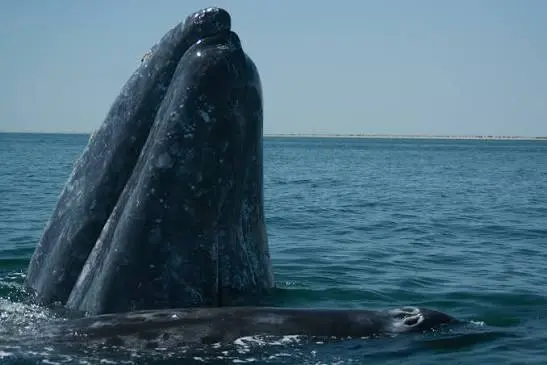
Yes. Gray whales still migrate to the Baja lagoons every winter, and Laguna Ojo de Liebre still records whales in the hundreds on peak survey dates. But the eastern North Pacific population is materially smaller than it was a decade ago. It fell from roughly 20,500 in 2019 to about 14,500 in 2023 during a declared Unusual Mortality Event, and the most recent count put it near 13,000, the lowest since the 1970s. Calf numbers remain the real concern. If you want to see gray whales in Baja, the encounters are still there, and where you go and who you go with now matters more than it did ten years ago.
Most whale watching pages will not tell you this. We would rather you booked knowing it.
What actually happened to the population
Between December 2018 and November 2023, NOAA declared an Unusual Mortality Event for eastern North Pacific gray whales. Across the migration route, 690 strandings were recorded: 347 in the United States, 316 in Mexico and 27 in Canada.
The population estimates tell the story more clearly than the stranding count.
| Year | Estimated population | Note |
| 2019 | About 20,500 | Start of the mortality event |
| 2023 | About 14,526 | Close of the mortality event |
| 2025 | About 13,000 | Lowest estimate since the 1970s, modelled range 11,700 to 14,500 |
That is a decline of roughly a third from the 2019 figure. The mortality event was formally closed in November 2023, but closure means strandings returned to expected levels, not that the population recovered.
Calf production is the number that matters most now. In 2025, roughly 85 gray whale calves were counted migrating past Central California, the lowest since that count began in 1994. A population can absorb elevated adult mortality if it is still breeding well. Low calf numbers across consecutive years are what make recovery slow.
Is this a reason not to go?
It is a fair question, and the honest answer has two parts.
Nothing about visiting the lagoons drives this decline. The leading explanation researchers point to is changing conditions on the Arctic feeding grounds, where gray whales build the fat reserves that carry them through a 10,000 mile round trip and a breeding season in which they barely feed. Whales arriving in Baja in poor condition produce fewer calves. That is an ocean-scale problem, not a lagoon-scale one.
Regulated whale watching is part of what protects these lagoons. Laguna Ojo de Liebre sits inside the Vizcaino Biosphere Reserve, a UNESCO World Heritage listed whale sanctuary. That protection exists in part because the lagoons have measurable value alive and undisturbed. The permits, boat limits and zone rules that constrain operators are funded and enforced within that same system.
The meaningful distinction is not whether you go. It is whether the operator you choose follows the rules that make the protection real. Our approach is set out on the responsible whale watching page.
Where the whales actually are
Population decline has not affected the three lagoons equally, and the distribution is more lopsided than most people expect.
Of documented mother and calf pairs across the Baja nursery lagoons, roughly 70 percent are recorded at Laguna Ojo de Liebre, about 14 percent at Laguna San Ignacio, and about 16 percent across the Bahia Magdalena and Bahia Almejas complex.
That concentration matters more in a low population year than in a strong one. When the total is smaller, the difference between a lagoon holding most of the nursery activity and one holding a seventh of it is the difference between a reliable trip and a hopeful one.
| Lagoon | Share of documented mother-calf pairs | Practical implication |
| Laguna Ojo de Liebre | About 70 percent | Highest and most consistent density, first sheltered lagoon on the migration |
| Bahia Magdalena complex | About 16 percent | Furthest south, more spread out across a large bay system |
| Laguna San Ignacio | About 14 percent | Strong historical reputation for friendly whales, materially fewer animals |
San Ignacio deserves a fair note here, because its reputation is genuine. It is the lagoon that made friendly whale behaviour famous, and people have extraordinary encounters there. The point is not that San Ignacio is a poor choice. It is that the raw numbers of animals present are considerably lower, which matters when you have a fixed number of days.
Our own lagoon by lagoon comparison, including boat zone limits and 2027 pricing, is in what the numbers actually show.
What this means for booking a 2027 trip
Five practical consequences.
1. Days on the water matter more than they used to. A single afternoon boat trip was a reasonable bet when the population was near 27,000. With numbers where they are, more days is the most effective way to protect your trip against weather and a slow day. This is the strongest practical argument for a camp over a day tour, and it is worth weighing when you compare our 4, 5 and 6 day itineraries.
2. Timing is less forgiving. The season runs from mid December to 30 April, and February and March remain the peak for mother and calf activity. In a lower population year, booking at the edges of the season carries more variance than it once did. Our week by week guide sets out how the season builds.
3. Boat density in your zone matters more. Fewer animals spread across the same number of boats means each boat works harder for an encounter. Laguna Ojo de Liebre is divided into three zones, and the zone off our camp is limited to six boats, against San Ignacio’s single zone permitting sixteen.
4. Be sceptical of guaranteed sightings. No operator can guarantee wildlife. What an operator can honestly offer is a location with the highest documented density, enough days to absorb a bad one, and a track record you can check. Anyone promising certainty in a low population year is telling you something about their marketing rather than about the whales.
5. Ask what the operator does when whales are scarce. The answer reveals a lot. Pressing closer, chasing, or crowding an animal to produce a photo is exactly the behaviour the zone rules exist to prevent.
How to tell a responsible operator from a good website
Six questions worth asking anyone you are considering, including us.
- Which lagoon, named exactly? “Baja” and “near the whale lagoons” are not answers. Ask for the lagoon and the zone.
- How many boats are permitted in that zone? A specific number should come back immediately.
- What are the rules on approaching whales, and who enforces them? Inside a biosphere reserve there are permit conditions. An operator should be able to describe them.
- What happens if a whale approaches the boat? The correct answer involves the engine, not the passengers leaning out.
- How long have you operated in this specific location? Baja Jones Adventures has run this camp for more than 25 years, which means a long record in the same water rather than a recently assembled itinerary.
- What do you tell guests about the population situation? An operator who has not mentioned it either does not follow the science or would rather you did not know.
What you can realistically expect to see
Being straight about this reduces disappointment more than any promise does.
| Element | Realistic expectation |
| Whales present | Yes, reliably in Ojo de Liebre through the core season |
| Close approaches | Common, particularly with calves, but never guaranteed on a given outing |
| Touching a whale | Happens when a whale chooses to initiate. It cannot be arranged or promised |
| Calves | Most abundant from early February onward |
| A blank day | Possible. Weather closes the water some days, which is why trip length matters |
| Photography | Best in morning light. Bring more lens than you think and protect it from salt spray |
More of what encounters actually look like is in our gallery and in guest accounts on expedition stories.
Frequently asked questions
Are gray whales endangered?
The eastern North Pacific gray whale was removed from the United States endangered species list in 1994 after recovering from commercial whaling, and it is not currently listed as endangered. However the population declined by roughly a third during the 2019 to 2023 Unusual Mortality Event, and the most recent estimate of about 13,000 is the lowest since the 1970s. It is being closely monitored.
How many gray whales are left?
The most recent count estimates about 13,000 eastern North Pacific gray whales, with a modelled range of roughly 11,700 to 14,500. That compares with about 20,500 in 2019 and about 14,526 at the close of the mortality event in 2023.
Why did gray whale numbers drop?
Researchers point primarily to changing conditions on the Arctic feeding grounds. Gray whales feed intensively in the Arctic and then largely fast through migration and the breeding season, so poorer feeding leads to whales arriving in worse condition, higher mortality and fewer calves. The 2019 to 2023 event recorded 690 strandings across the United States, Mexico and Canada.
Are there still enough whales to make a Baja trip worthwhile?
Yes, particularly at Laguna Ojo de Liebre, which holds roughly 70 percent of documented mother and calf pairs across the Baja nursery lagoons and records whales in the hundreds on peak survey dates. What has changed is that lagoon choice and trip length matter more than they did when the population was larger.
Is whale watching bad for the whales?
Regulated whale watching inside the Vizcaino Biosphere Reserve operates under permit conditions, defined zones and boat limits designed to limit disturbance. The protection of these lagoons is closely tied to their value as a living sanctuary. Unregulated or aggressive boat behaviour is a genuine problem, which is why the operator you choose matters more than whether you go.
When is the best time to see gray whales in Baja?
The season runs from mid December to 30 April. February and March are the peak for mother and calf activity, with the first calves generally appearing in early February and calves often becoming most curious toward the end of the season.
Which Baja lagoon has the most gray whales?
Laguna Ojo de Liebre. It holds roughly 70 percent of documented mother and calf pairs, against about 14 percent at Laguna San Ignacio and about 16 percent across the Bahia Magdalena complex. It is also the first major sheltered lagoon whales reach on the southbound migration.
Can you guarantee I will see whales?
No, and no honest operator can. What we can tell you is that we operate on the lagoon with the highest documented density, in a six boat zone, with multiple days on the water so a single poor weather day does not decide your trip.
Planning a 2027 trip
The gray whale population is smaller than it was, the reasons sit largely in the Arctic rather than in Baja, and the lagoons remain the most reliable place on earth to be close to these animals. Those three things are all true at once.
If you are deciding on dates, view the 2027 schedule and pricing, see what a stay at Gray Whale Camp includes, or read about the other species you may encounter in the reserve.
For questions about dates, travel routes or what a specific week is likely to be like, get in touch. We will give you a straight answer, including if we think a different week suits you better.
About the author
Keith Jones has operated whale watching camps on Laguna Ojo de Liebre for more than 25 years through Baja Jones Adventure Travel. Read more about Keith.