
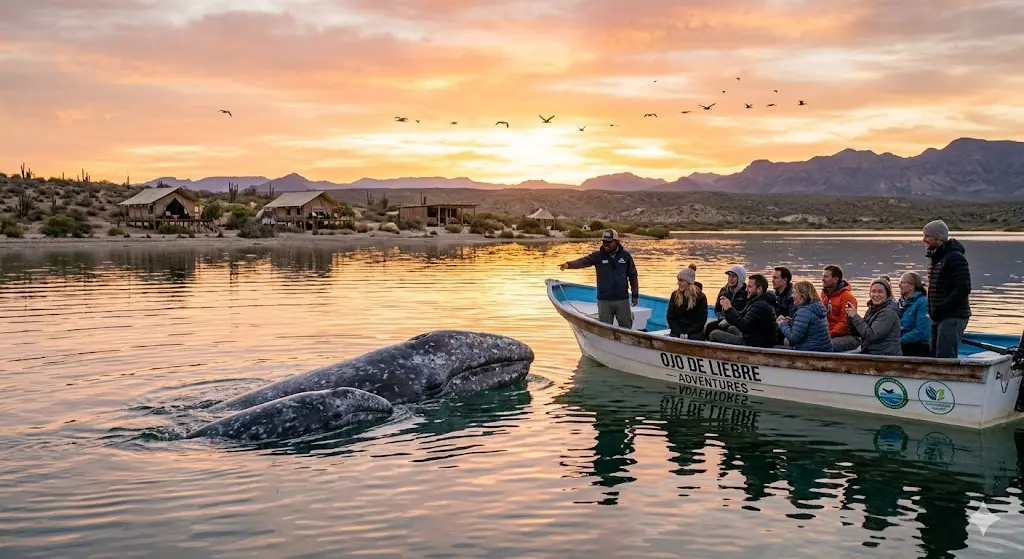
The best whale watching in Baja happens from January through late March, when gray whales fill the sheltered Pacific lagoons of Baja California Sur to give birth, and blue whales gather in the Sea of Cortez near Loreto to feed. Gray Whale Camp, run by Baja Jones Adventure Travel and founded by Keith Jones, has guided close encounter whale watching trips in Mexico from Laguna Ojo de Liebre since 1994.
If you are searching for whale watching in Baja or whale watching in Mexico more broadly, you have several real options: gray whales in the Pacific lagoons, blue whales in the Sea of Cortez, or a combination trip that covers both. This guide walks through the season, the locations, and what actually separates one Baja whale watching trip from another.
Why Baja Is One of the Best Places for Whale Watching in Mexico
Baja California and the neighboring Sea of Cortez support one of the richest concentrations of marine mammals anywhere in the world. Gray whales, blue whales, fin whales, humpback whales, orcas, sperm whales, and large pods of dolphins all pass through the region during the winter and early spring months. You can explore the full range of species on the Whale Species and Wildlife of Baja California page.
What makes Baja unique is not just the number of species, it is the access. The Pacific lagoons of Baja California Sur are among the few places where gray whales approach boats voluntarily, often bringing newborn calves within arm’s reach.
Best Time for Whale Watching in Baja California
Whale watching season in Baja is driven by two separate migrations that overlap on the calendar.
- Gray whales: travel more than 5,000 miles from the Bering Sea and Arctic coastline to reach Baja’s lagoons. The first arrivals appear as early as December, with the main season running January through late March and sometimes into April.
- Blue whales: gather in the Sea of Cortez near Loreto from January through April to feed on dense krill blooms, with the strongest concentration in February and March.
Because both seasons overlap, a single trip can realistically include gray whales in the Pacific lagoons and blue whales near Loreto. See current dates on the 2027 whale watching schedule.
Where to Watch Whales in Baja: Comparing the Top Locations
Laguna Ojo de Liebre (Scammon’s Lagoon)
Located near Guerrero Negro, Laguna Ojo de Liebre is the closest gray whale lagoon to the US border and sits inside the protected Vizcaíno Biosphere Reserve. The lagoon is divided into three whale watching zones, with Gray Whale Camp positioned on the shore of Zone 2, where only a small number of boats are permitted at a time. According to Mexican government census figures tracked by Gray Whale Camp, Laguna Ojo de Liebre has recorded several times more whales than nearby San Ignacio Lagoon during comparable weeks of the same season. Guests board boats from a dock rather than wading through the water.
San Ignacio Lagoon
San Ignacio is a well known alternative about 150 miles south of Laguna Ojo de Liebre. It operates a single whale watching zone permitting up to sixteen boats at once, and visitors typically wade out to small boats called pangas, often with wet feet and gear in cooler morning temperatures.
Loreto and the Sea of Cortez
On Baja’s eastern coast, the Sea of Cortez near Loreto is a completely different ecosystem, sometimes called Jacques Cousteau’s “aquarium of the world.” Rather than gray whales in a lagoon, this UNESCO recognized marine region is where blue whales, fin whales, and humpback whales feed in open water. Read more on the whale watching in Loreto page and the Baja California travel guide.
Gray Whale Watching in Baja: What to Expect at the Lagoon
Laguna Ojo de Liebre is a favorite nursery for gray whales, where mothers give birth and teach their calves to swim before the long return migration north. Guests staying at the lagoon-side camp often hear whales breathing in the night air, then head out by boat the next morning to watch calves surface just beside the hull, sometimes closer than their mothers intend. Full details on the camp experience, accommodations, and daily itinerary are on the Gray Whale Watching Baja Camp page.
Blue Whale Watching Near Loreto: Earth’s Largest Animal
Blue whales can reach nearly 100 feet in length and up to 200 tons, making a close encounter in the Sea of Cortez one of the most dramatic wildlife experiences available anywhere. Winter populations near Loreto are generally estimated between ten and twenty adult blue whales each season, alongside fin whales and migrating humpbacks. Peak viewing runs February through March. Learn more about the Sea of Cortez blue whale season and the dedicated Blue Whale Expeditions near Loreto.
How to Choose a Responsible Whale Watching Tour in Baja
Not every whale watching operator in Mexico follows the same standards. Before booking, look for these signs of a responsible operation.
- Licensed boat operators who understand federal whale watching regulations.
- Defined zones and boat limits that reduce pressure on breeding and nursing whales.
- Protected refuge areas where boats are not permitted at all.
- Experienced guides who let encounters happen on the whale’s terms rather than forcing interaction.
- Decades of field time, not just a seasonal contract with a local boat operator.
These are the same standards Gray Whale Camp has followed since 1994, detailed further on the Responsible Whale Watching in Baja California page.
Trip Options and What a Baja Whale Watching Trip Costs
Gray Whale Camp runs four, five, six, eight, and ten day itineraries between late January and late March. Pricing generally starts around 2,995 dollars for a shorter gray whale trip and reaches roughly 5,195 dollars for the ten day combination trip that pairs gray whales at Laguna Ojo de Liebre with blue whales near Loreto. Prices rise as each departure date fills, so the earliest sign-ups get the lowest rate, and there is no single supplement fee for solo travelers. Full pricing by date is on the 2027 schedule page.
Meet Your Guide
Keith Jones has followed the gray whale migration into Baja’s lagoons every season since 1994, and has led blue whale expeditions in the Sea of Cortez near Loreto since 2004. His decades of direct field observation, rather than a seasonal contract, shape how Gray Whale Camp operates every trip. Read his full story on the About Keith Jones page.
Frequently Asked Questions
When is the best time for whale watching in Baja?
The best time for whale watching in Baja is January through late March. Gray whales arrive in the Pacific lagoons of Baja California Sur as early as December and stay through March or April. Blue whales gather in the Sea of Cortez near Loreto from January through April, with peak sightings in February and March.
What is the difference between gray whale and blue whale season in Mexico?
Gray whales migrate to sheltered Pacific lagoons such as Laguna Ojo de Liebre to give birth and nurse calves between December and April. Blue whales gather instead in the Sea of Cortez near Loreto, feeding on krill from January through April with a peak in February and March. Because the seasons overlap, combination trips covering both are possible.
Which is better, Laguna Ojo de Liebre or San Ignacio Lagoon?
Laguna Ojo de Liebre is closer to the US border, sits inside the protected Vizcaíno Biosphere Reserve, and is divided into three whale watching zones rather than San Ignacio’s single zone. Census data tracked by Gray Whale Camp shows Laguna Ojo de Liebre typically records several times more whales than San Ignacio during comparable weeks. Boats at Laguna Ojo de Liebre also load from a dock, while San Ignacio requires wading out to the pangas.
How much does a Baja whale watching trip cost?
Trips with Gray Whale Camp range from roughly 2,995 dollars for a four day gray whale trip up to 5,195 dollars for a ten day combination trip covering both gray whales and blue whales. Prices rise as each date fills, so early booking secures the lowest rate.
Do I need to wade into the water to board the whale watching boats?
Not at Laguna Ojo de Liebre. Gray Whale Camp uses a dock, so guests step directly into the boats, unlike San Ignacio Lagoon where visitors typically wade out to board.
Is whale watching in Baja safe for solo travelers?
Yes. Gray Whale Camp has guided trips since 1994 and charges no single supplement fee, so solo travelers pay the same rate as those sharing accommodations. Licensed operators, defined whale watching zones, and decades of experience are part of every trip.
Book Your Baja Whale Watching Trip
Whether you want an intimate gray whale encounter in the lagoon, a blue whale expedition near Loreto, or a combination trip covering both, the earliest booked dates get the best pricing and the best availability. Contact Gray Whale Camp to start planning, or review the full 2027 whale watching schedule to pick your dates.